


About Brian DeChesare
Brian DeChesare is the Founder of Mergers & Inquisitions and Breaking Into Wall Street. In his spare time, he enjoys lifting weights, running, traveling, obsessively watching TV shows, and defeating Sauron.
EBITDAR, defined as Earnings Before Interest, Taxes, Depreciation, Amortization, and Rent, is used to normalize companies with different leasing vs. ownership policies and to normalize differences between U.S. GAAP and IFRS following changes to lease accounting in 2019.
EBITDAR Tutorial
EBITDAR Definition: EBITDAR, defined as Earnings Before Interest, Taxes, Depreciation, Amortization, and Rent, is used to normalize companies with different leasing vs. ownership policies and to normalize differences between U.S. GAAP and IFRS following changes to lease accounting in 2019.
In the EBITDA tutorial on this site, we referenced the scene between Tony and Paulie in The Sopranos, where they discuss the meaning of EBITDA in the context of a potential business sale.
But you may have noticed they never mentioned EBITDAR, as it’s too obscure even for the mafia in New Jersey.
Although Paulie claims that EBITDA gives “the true picture of a company’s profitability,” that’s not the case, as it’s more of a normalization or comparison metric.
By adding back the Rental Expense to EBITDA, EBITDAR moves even further away from “profitability” and toward “normalization.”
Ever since IFRS 16 went into effect in 2019, EBITDAR has been most useful when analyzing U.S.-based companies with different leasing and ownership policies.
For example, it’s helpful to normalize cases in which Company A rents 100% of its equipment and Company B owns 100%:
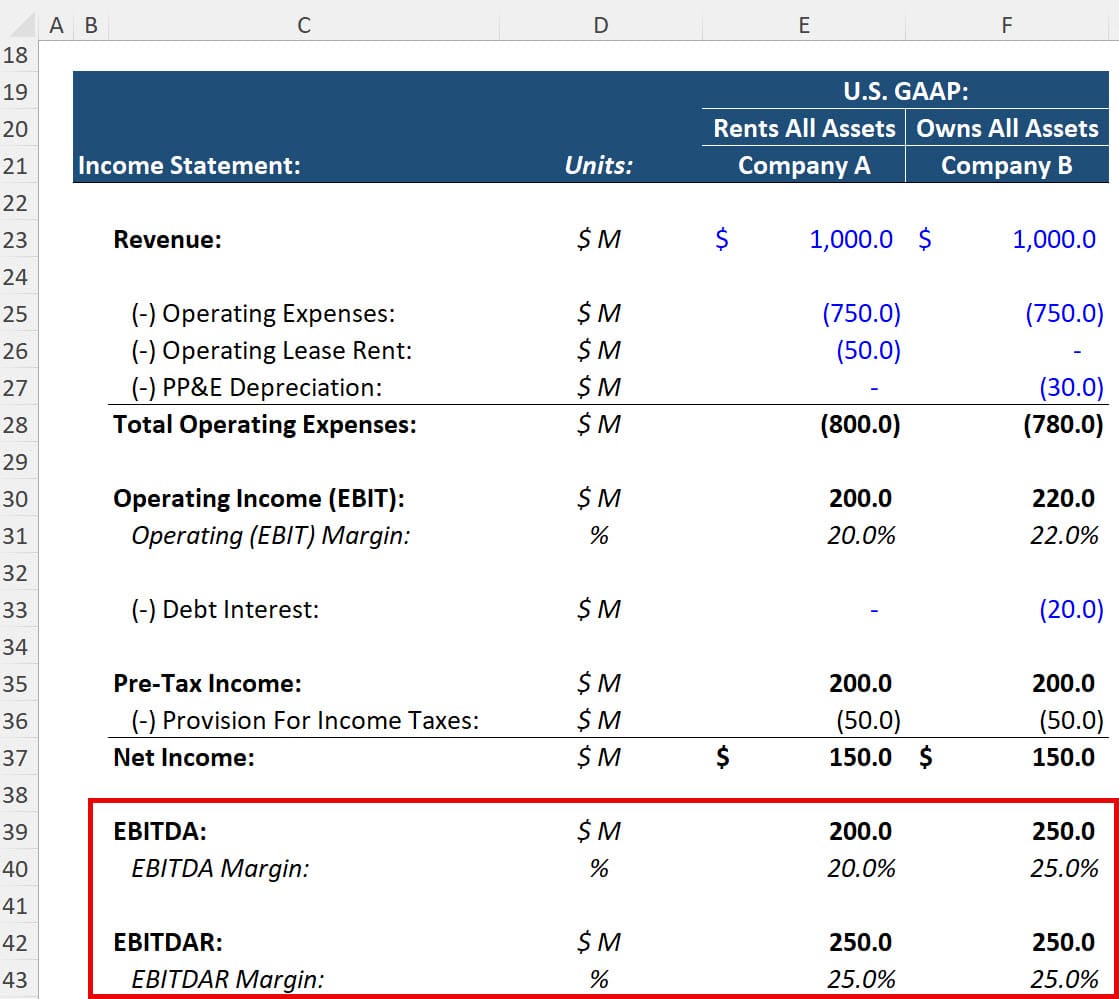
But since IFRS treats leasing and debt-financed ownership the same way (the full expense is split into Depreciation, Interest, and Principal Repayment components), it’s no longer useful there.
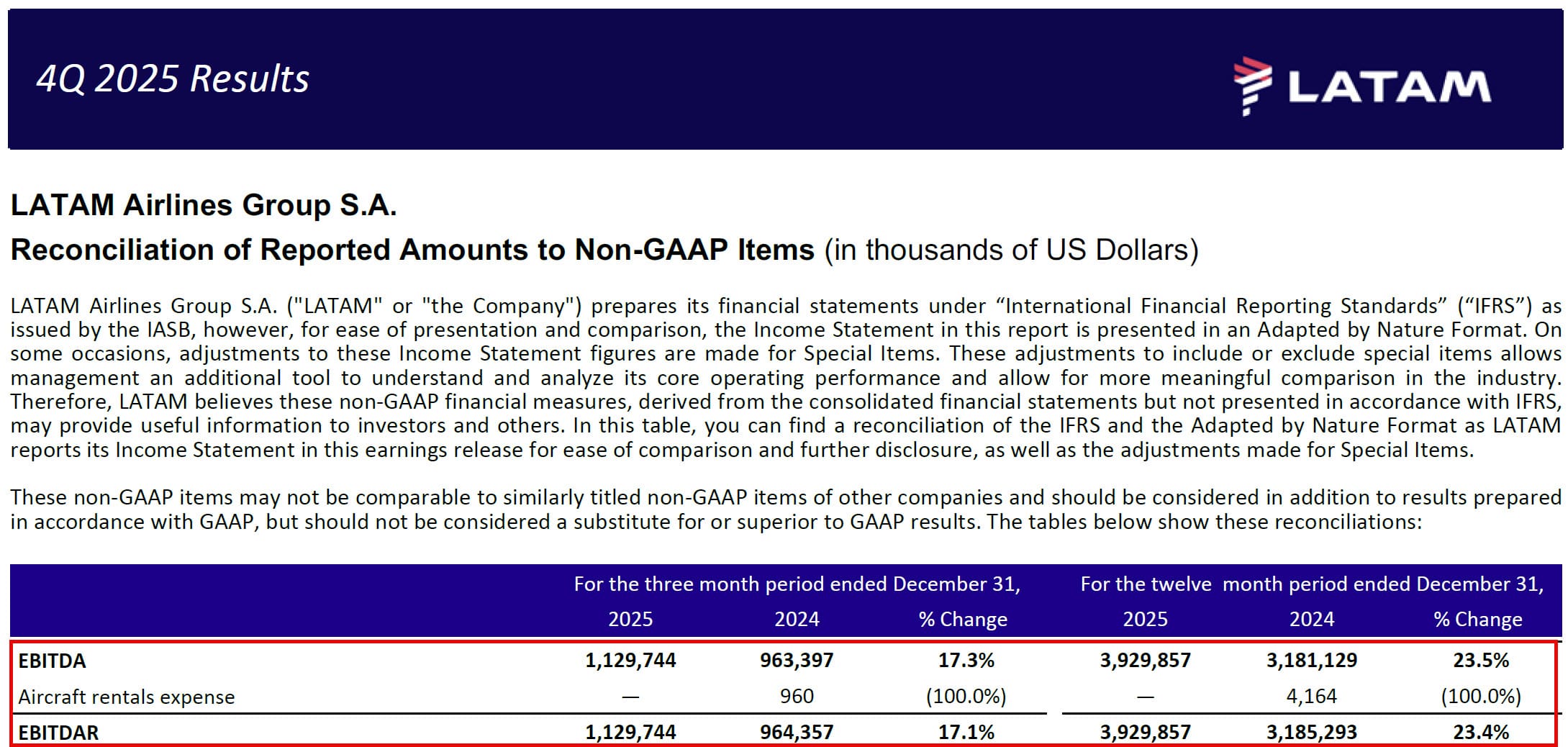
EBITDA and EBITDAR are the same or very close ~99% of the time under IFRS, with some minor differences due to short-term lease expenses that might still be recorded as “Rent” on the Income Statement.
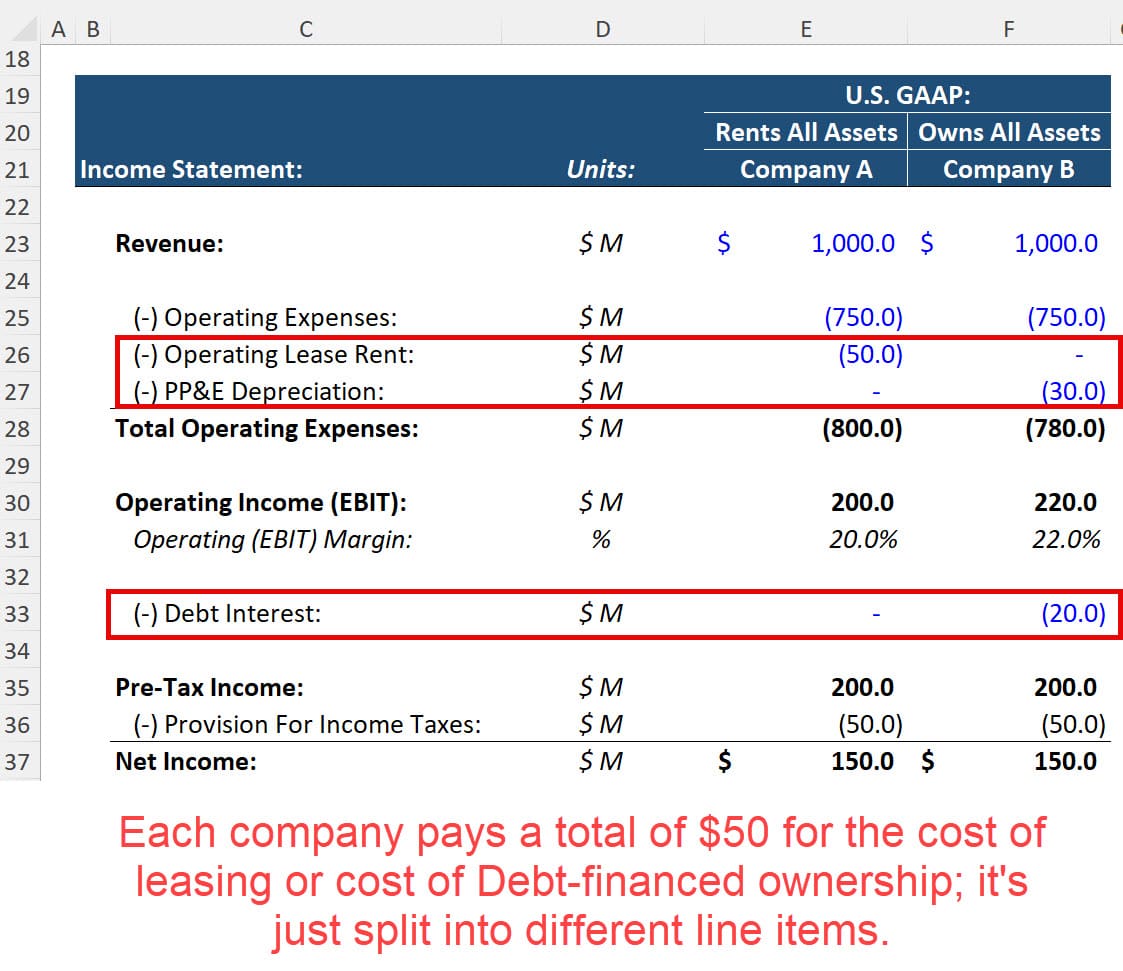
Suppose that you are analyzing two companies, both of which follow U.S. GAAP. Company A rents all its equipment and properties, while Company B owns its equipment and properties directly, having issued Debt to fund them in earlier years.
To illustrate the problem, we assume here that these companies have identical financials, including identical costs of leasing and ownership:
If you used EBITDA to compare these companies, it would give you a misleading idea of their core businesses:
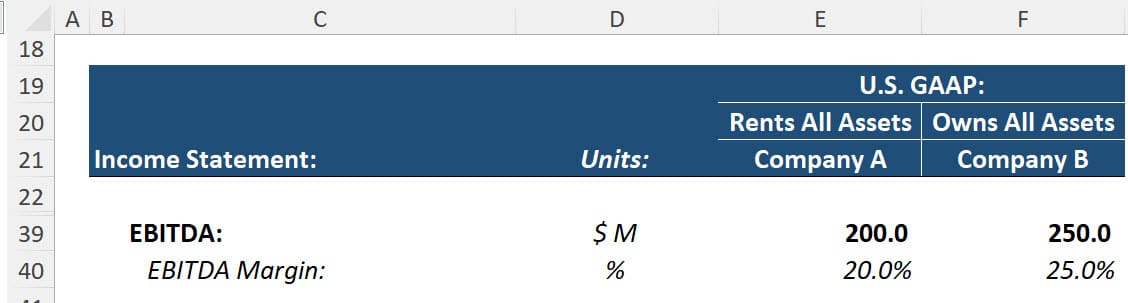
This is because under U.S. GAAP, EBITDA excludes the cost of Debt-funded ownership since it is before Interest and Depreciation.
Interest represents the Cost of Debt, and Depreciation represents the Cost of Asset Ownership.
Therefore, EBITDA is always higher for a company that owns all its assets and lower for a company that rents them.
To adjust, we can add back Company A’s Rental Expense:
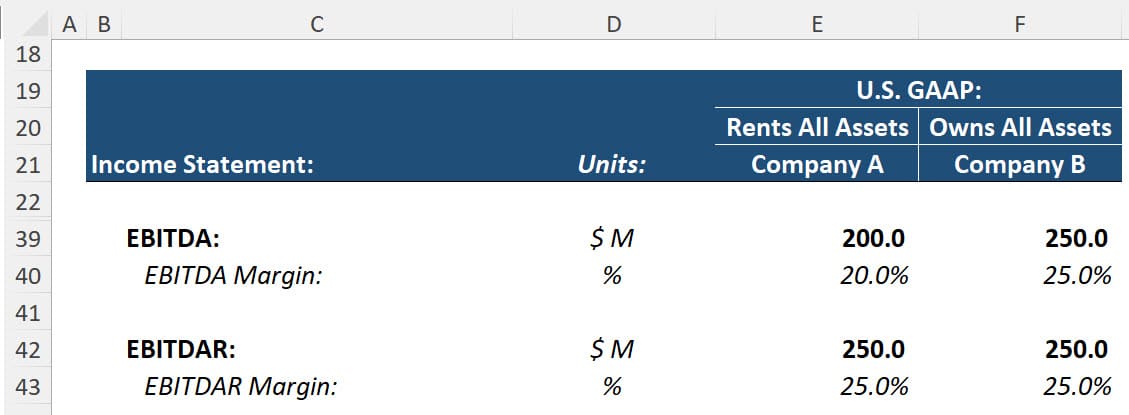
With this change, both companies appear to have the same earnings power from their core businesses.
This is an accurate representation of reality, as leasing vs. owning is an operational decision that should not affect intrinsic value.
After IFRS 16 went into effect in 2019, EBITDAR became somewhat pointless if you are analyzing solely non-U.S. companies.
This is because under IFRS, all leases are recognized the same way as Debt-funded asset ownership.
In other words, the Lease Expense is split into Interest and Depreciation on the Income Statement, and on the Cash Flow Statement, the Lease Depreciation is added back, and the Lease Principal Repayments are subtracted.
So, under IFRS, this same scenario with rented vs. owned assets would appear like this:
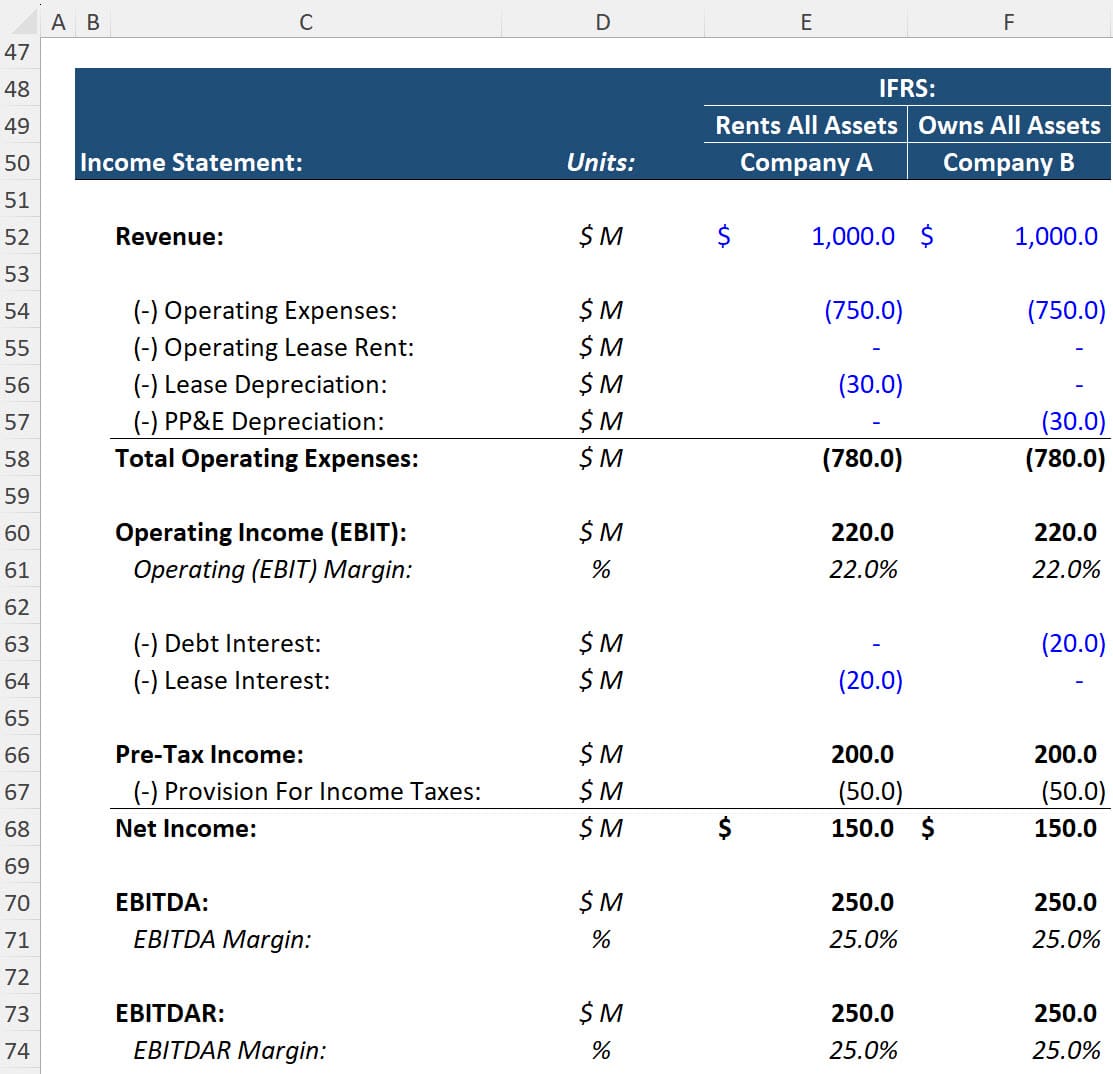
There is no Rental Expense to add back because the company “pretends” that the lease results in Interest and Depreciation, even though it is still paying a simple fixed amount for it.
We label EBITDAR “somewhat pointless” rather than “outright pointless” because short-term leases that last less than 1 year may still be recorded in the “Rental Expense” line on the Income Statement.
So, EBITDA and EBITDAR still differ in some cases, but this difference tends to be very modest, even for an asset-heavy company like an airline (example for LATAM below):
When you calculate valuation multiples and other metrics based on EBITDAR, you must include the full Lease Liabilities in the numerator.
If the denominator of a valuation multiple excludes or adds back an expense, the numerator should include or add the corresponding Liability.
For example, EBITDA excludes Interest, so the Enterprise Value numerator in the TEV / EBITDA multiple includes the corresponding Debt liability.
Under IFRS, including the full Lease Liabilities in Enterprise Value is the default treatment because EBITDA and EBITDAR both already exclude the full Lease Expense.
Under U.S. GAAP, it’s trickier because Operating Leases and Finance Leases are treated differently.
But let’s look at the simpler case first by returning to the original scenario, with Company A renting 100% of its assets and Company B owning 100% of its assets.
To calculate TEV / EBITDAR, you add the full Lease Liabilities in Enterprise Value for both companies and add Rent to move from EBITDA to EBITDAR.
Company B does not have any Lease Liabilities or Rent – just a Debt balance:
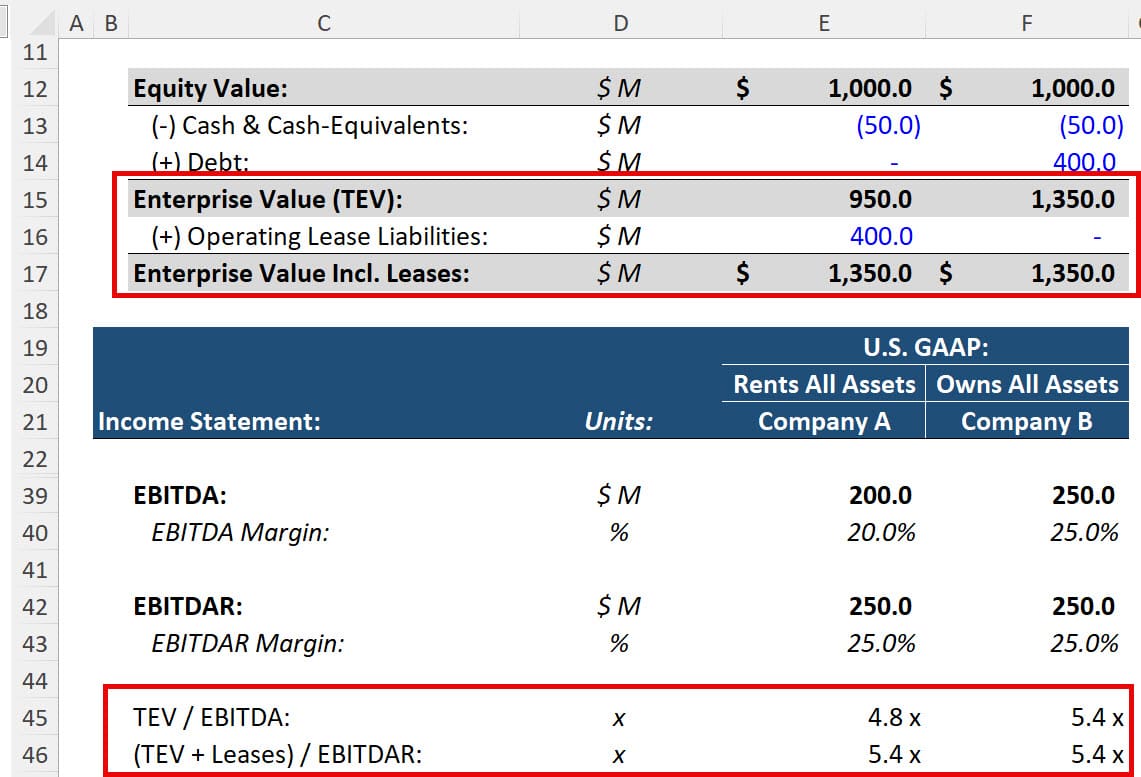
With this setup, we normalize for the lease vs. own decision and reach similar conclusions about each company’s valuation.
EBITDAR and EBITDAR-based multiples are also useful in cases where U.S.-based companies rent their assets under different lease types.
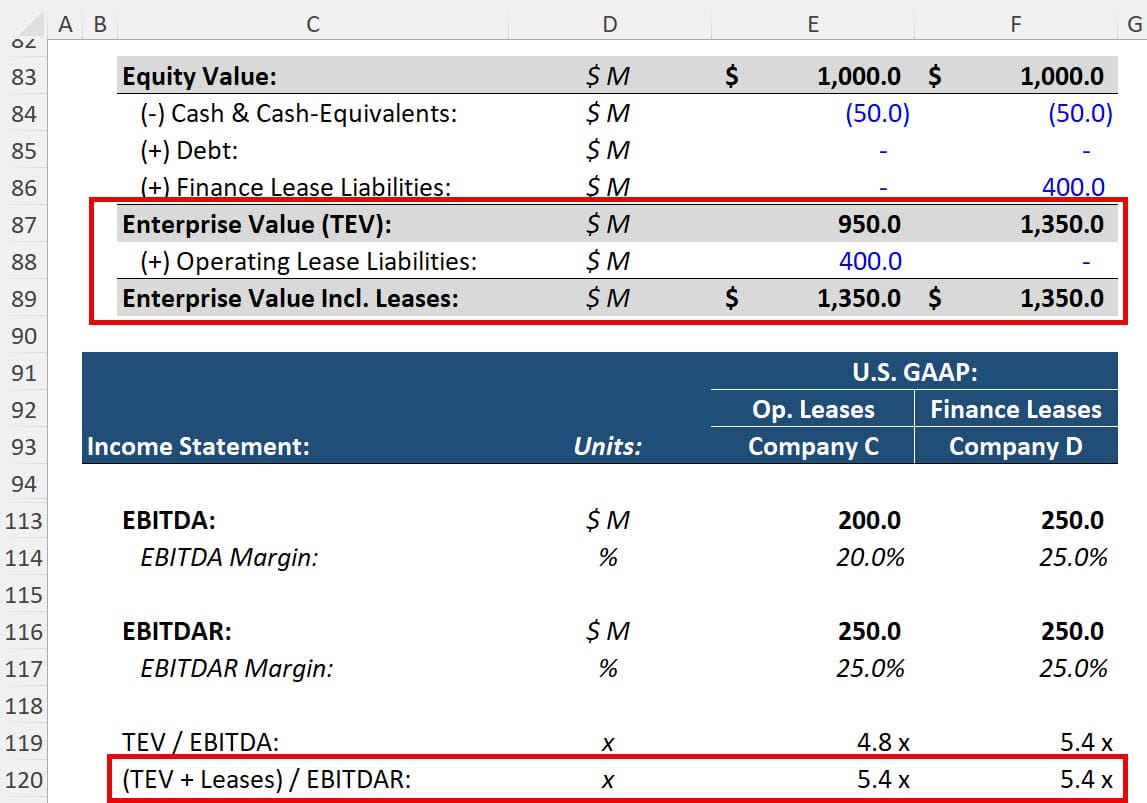
For example, suppose that Company C and Company D both lease 100% of their equipment, but Company C uses all Operating Leases, and Company D uses all Finance Leases.
Finance Leases are closer to “ownership” because there may be a transfer or bargain purchase option at the end, the contract life is longer, and the Present Value of lease payments may exceed 90% of the asset’s fair market value – but in both cases, the company pays a simple cash expense for the lease.
Under IFRS, there is no issue because EBITDA is the same for both companies, and Enterprise Value includes both Operating and Finance Lease Liabilities.
But under U.S. GAAP, we run into an issue because EBITDA adds back the Finance Lease Expense (Interest and Depreciation), but not the Operating Lease Expense (Rent).
Therefore, Enterprise Value includes the Finance Lease Liability, but not the Operating Lease Liability, which creates a comparability issue:
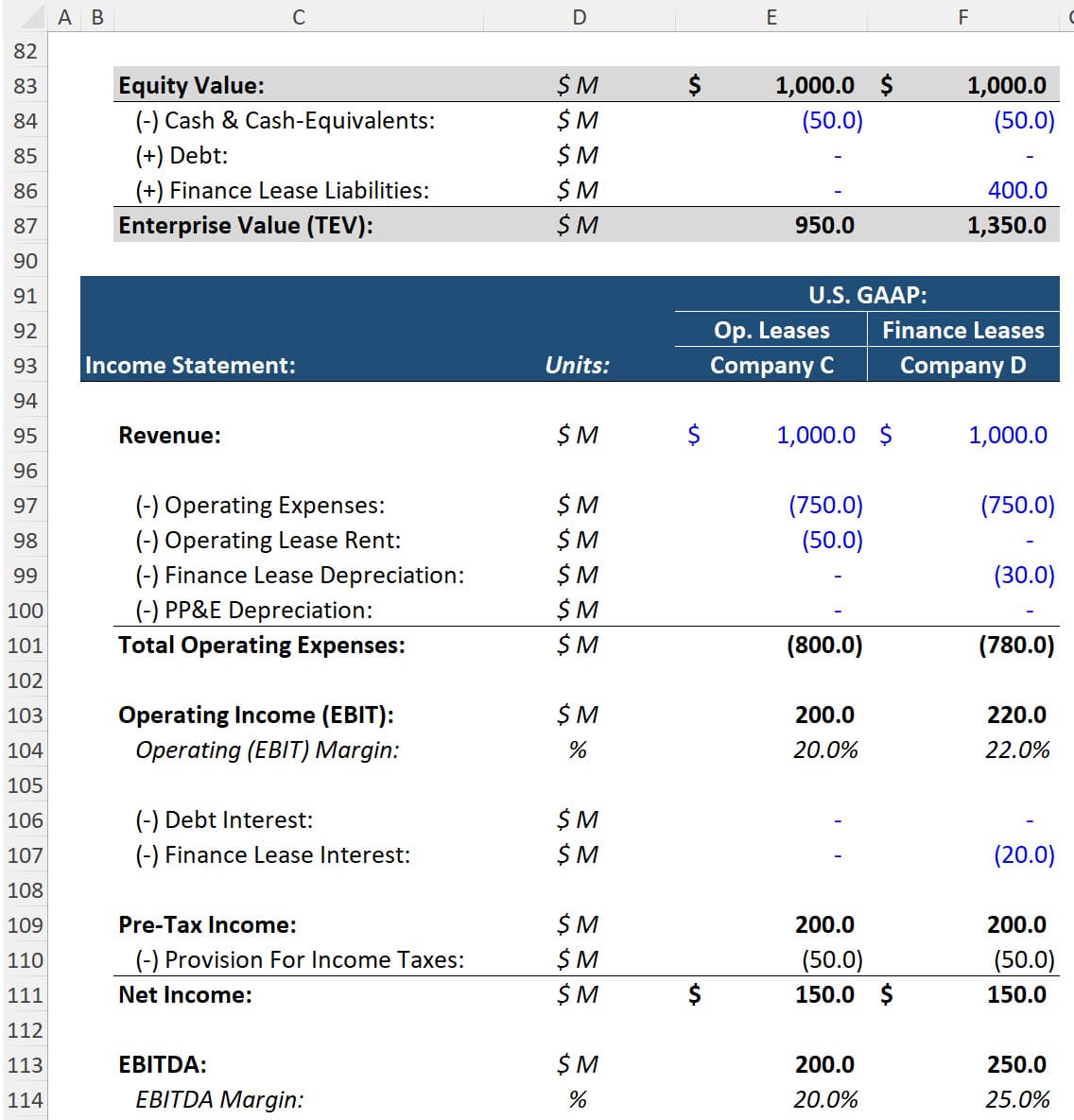
The simplest fix is to use Enterprise Value Including Lease Liabilities and EBITDAR rather than standard Enterprise Value and EBITDA:
If you are calculating metrics such as the Leverage Ratio, normally defined as Debt / EBITDA, the same principle applies.
In other words, under U.S. GAAP, “Debt” normally includes Finance Lease Liabilities since EBITDA excludes the Finance Lease Interest and Finance Lease Depreciation.
But if you use EBITDAR, the numerator should be Debt Including All Lease Liabilities because the EBITDAR denominator excludes Rent as well:

Even though EBITDA and EBITDAR are effectively the same under IFRS, EBITDAR can still be useful when you are comparing U.S. and non-U.S. companies.
Normally, you screen comparable companies by geography, and specific screens are better than general ones (e.g., just the U.S., just Europe, or just East Asia).
However, it’s not possible to do this in certain industries because many companies operate globally and have headquarters across multiple countries.
One example is Oilfield Services, covered in our Oil & Gas Modeling course.
One case study in that course is based on China Oilfield Services, and its valuation is based on a global screen of companies in Europe, the Middle East, and North America:
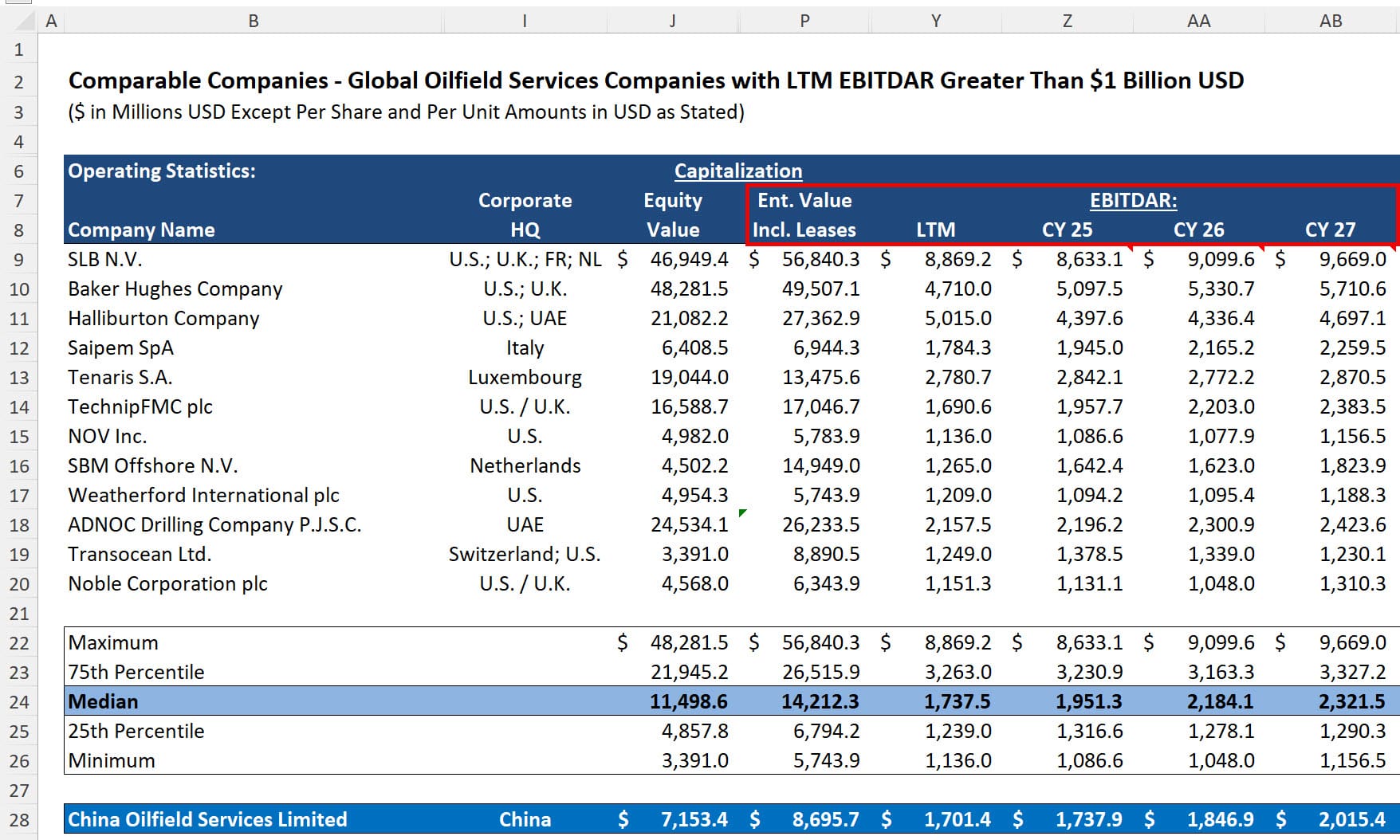
EBITDAR and (TEV + All Lease Liabilities) / EBITDAR are useful here because the U.S.-based companies record Rental Expense for their Operating Leases.
By adding this expense back and adjusting the Enterprise Value figure for all the U.S.-based companies, we get a better idea of their relative values.
The analysis would not necessarily be “wrong” if we used normal EBITDA, especially since Rent is modest for most of these firms, but it would be less accurate.
In the episode of The Sopranos referenced in the beginning, Paulie argues that EBITDA is “the true picture of a company’s profitability.”
As explained in the EBITDA tutorial, this is not the case.
EBITDA is more like a company’s “adjusted cash flow,” and while it’s useful for comparison purposes, it tends to be quite different from metrics such as Cash Flow from Operations, Free Cash Flow, and even Unlevered Free Cash Flow.
EBITDAR is an even more extreme case.
Since it adds back the full costs of leasing and ownership, it departs even further from a company’s “true profitability.”
However, EBITDAR is still useful as a comparison/normalization tool for U.S. companies, and if you’re ever comparing IFRS and U.S. GAAP-based companies in the same set.
And if you ever want to sell your company and your adviser can’t explain EBITDA vs. EBITDAR, please ask Paulie or Tony to pay him a visit.

Brian DeChesare is the Founder of Mergers & Inquisitions and Breaking Into Wall Street. In his spare time, he enjoys lifting weights, running, traveling, obsessively watching TV shows, and defeating Sauron.

