


Master PE Fund Investment, Co-Investment, and Secondaries Case Studies
Understand the key PE fund concepts
You’ll get an introductory crash course that explains everything
Learn fund-level modeling
Build fund analyses, waterfalls, and portfolio company projections
Complete 6 case studies
Learn the Excel analyses and how to recommend investments
View short course outline or scroll down for the details
In this section, we normally write about other courses on the market and explain why they come up short for learning about PE funds of funds and secondaries.
But let’s be real: There aren’t really any other full Excel-based courses on these topics.
In fact, that probably explains why you’re here: You’ve looked for training and case study practice but haven’t found much.
If that’s you, the BIWS Private Equity Funds of Funds and Secondaries course is your solution.
It covers everything from the fundamental concepts – capital calls, carried interest, management fees, and TVPI – up through more advanced, real-world case studies.
As secondaries gain popularity, more courses will pop up. But without a solid understanding of fund-level mechanics and metrics, you will never “get” the full picture of secondaries or co-investments.
That is why this course begins with the fundamental concepts and then progresses to more advanced, real-world case studies.
The training here is based on our ~20 years of experience working with students and professionals and gathering the case studies and modeling tests they were given in real life at the top funds of funds and secondaries groups.
We took these real-life evaluations, tweaked them, switched the companies and deals, and broke them into step-by-step training.
Think of the lessons here as “high-calorie info snacks” that you can digest 24/7.
If you follow along with this course, you will be prepared for anything they could throw at you because our examples are more difficult than most real-life exercises.
The approach used in this course involves 3 core elements:
1) Conceptual Mastery – Before completing the full case studies, you must understand concepts such as committed vs. invested capital, management fees, carried interest, waterfall schedules with hurdle rates, and key metrics such as TVPI, DPI, RVPI, and the Gross and Net IRR. So, the entire first module of the course acts as a “crash course” to cover these points efficiently.
It also introduces you to concepts such as fund recycling, co-investments, and LP- and GP-led secondaries deals in which a firm acquires a stake in an existing PE fund or a specific portfolio company via a continuation vehicle (CV).
2) Excel Practice – Starting in Module 1, you’ll get practice implementing all of these concepts in Excel, including “track record” analyses of PE funds, portfolio company projections, and waterfall schedules.
You’ll also learn how to take traditional leveraged buyout (LBO) models and “layer in” fund-of-fund features to support co-investment and GP-led secondary deals.
3) Investment Recommendations – Finally, you’ll get several examples of how to put together all the pieces to make investment recommendations for new funds, co-investments, and stakes in existing funds.
The goal is to go beyond the numbers and consider the market, team, and competitive factors that can make or break a deal.
There’s a lot here, and everyone is increasingly pressed for time – so we’ve also created study plans for different schedules, such as 5-10 hours or 15 hours.
If you just want a weekend crash course on the key points, you can get that here.
But if you want to dive into each model and meticulously complete all the steps, you can also take that approach.
The course is divided into the introductory module (Module 1) and 6 full case studies. Through these cases, you’ll learn to:
- Understand private equity fund mechanics and calculate the management fees, carried interest, and key metrics (IRR, MOIC, TVPI, DPI, RVPI, etc.).
- Set up European and American waterfall structures with hurdle rates, preferred returns, and GP catch-up returns.
- Build an LP-led secondary model with support for a bid discount and expected portfolio company exit dates and values.
- Modify a traditional LBO model to support a GP-led secondary transaction for a single asset via a continuation vehicle (CV).
- Model the historical cash flows for a current PE fund, including post-record-date calls and exit proceeds.
- Analyze multiple PE funds operated by a single firm, aggregate the cash flows, and set up American waterfall schedules for the remaining unrealized portfolio companies.
- Estimate an existing PE fund’s Gross and Net IRR and MOIC by deal type/size, process type, seller type, and team member.
- Draft full investment recommendation presentations for new funds, co-investments, and secondary deals.
- Tweak a traditional LBO model to make it support a co-investment opportunity and add co-investor alignment and fund-level analysis.
- Forecast the cash flows, valuations, and exit proceeds for entire private equity portfolios based on outside industry research and the GP’s business plans.
- Add more advanced LP-led secondary features, such as post-record-date adjustments, purchase price deferrals, and a full European waterfall for the carried interest.
- Build a GP-led secondary model for a healthcare SaaS company, with support for the CV structure, carried interest rollover, and management fees.
If you want the skills required to analyze PE funds, co-investments, and secondaries without spending years in the industry, this is the course for you.

Brian DeChesare
Founder, Breaking Into Wall Street
Here’s What You’ll Get When You Sign Up for This Private Equity Funds of Funds and Secondaries Course:


Module 1: Introduction to PE Fund Funds of Funds and Secondaries

WHY IT’S IMPORTANT: This module provides a “crash course overview” of the most important PE fund and secondaries concepts, so you can get up to speed in a day.
In this introductory module, you’ll learn all about private equity fund analysis and secondaries investing, including terms such as committed and invested capital, carried interest, management fees, and preferred and catch-up returns.
You will learn how to calculate metrics such as the TVPI, DPI, RVPI, Gross/Net IRR, Gross/Net MOIC, and the accrued and distributed carried interest under American vs. European waterfalls.
Other topics covered include fund recycling, co-investments, the Net Asset Value (NAV) of a fund, and how to calculate the potential returns of a secondary investment to acquire a stake in an existing PE fund.

Module 2: Historical Evaluation of a Private Equity Fund

WHY IT’S IMPORTANT: This case study explains how to apply many of the concepts taught in Module 1 to evaluate a private equity fund’s historical performance.
In this module, you’ll complete a 90-minute case study in which you analyze the historical performance of a lower-middle-market private equity fund, calculate key metrics for the fund and individual portfolio companies, and update the analysis for transactions after the evaluation date.
You will learn how to apply metrics such as TVPI, DPI, MOIC, and IRR in real life, how to calculate Carried Interest under different scenarios, and how to use these numbers to form a view of a PE fund’s strengths and weaknesses.

Module 3: Multi-Fund Analysis and More Advanced Cash Flow Modeling

WHY IT’S IMPORTANT: This module is a direct example of a real-life PE fund of funds case study; the tutorials walk you through the evaluation process step-by-step.
In this module, you’ll analyze multiple private equity funds and examine trends across the firm’s investment and sourcing strategies to make a recommendation on an investment in its upcoming Fund VI. This case includes a full slide presentation and a Word version of this recommendation.
You will also get practice building an American waterfall structure for Carried Interest for several exited portfolio companies and learn how to make rough estimates for metrics such as the Net MOIC and Net IRR when the full cash flow data is not available.

Module 4: Co-Investment and PE Fund Analysis

WHY IT’S IMPORTANT: This training combines traditional LBO modeling with fund-level analysis and explains how to factor in both an individual asset and the entire fund when making an investment recommendation.
You will complete a PE fund and co-investment analysis in this case study, based on a pan-European firm with 7 previous and current funds across multiple sectors. You will examine the firm’s sourcing strategies, deals, sectors, regions, and deal sizes.
In the co-investment analysis, you will build an LBO model for Gerresheimer AG, a German life science tools and services company, and develop your own operational and exit assumptions to challenge the GP’s case.
This case study includes a full slide presentation for the investment recommendations and a written document with answers to the case questions.

Module 5: LP-Led Secondary Deal Analysis

WHY IT’S IMPORTANT: This case study walks you through a “portfolio company evaluation” exercise that you’ll often have to complete in interviews with secondaries firms and private capital advisory groups at banks.
In this module, you’ll complete a 3-hour case study in which you analyze a middle-market private equity fund’s existing portfolio companies in the consumer and industrial sectors. You’ll complete a bottoms-up forecast for each company, build in exit multiples and exit dates, and use outside research and provided data on the public comps to support your numbers.
You will learn how to calculate the key metrics and ratios in an LP-led secondary deal in which an existing Limited Partner sells its stake in the entire fund, and you’ll aggregate the cash flows to build a returns analysis, sensitize the results, and answer the case study questions about the appropriate price for this portfolio and the fund’s overall strengths and weaknesses.

Module 6: More Advanced LP-Led Secondary Deal Analysis

WHY IT’S IMPORTANT: This module expands on the previous LP-led secondary case studies and adds more advanced features and outside research so you can ground your assumptions and recommendation more effectively.
In this module, you will complete a more advanced LP-led secondary case study based on a private equity firm that invests in healthcare and technology companies. You will build mini-cash flow/LBO models for each company, estimate their exit values, and support your findings with outside research.
You will also build a fund-level waterfall schedule to calculate the Carried Interest and factor in the Management Fees more accurately. You will aggregate the results from this to calculate the Selling LP’s NAV, reflect Record Date vs. Closing Date differences, and build in a Purchase Price Deferral option.
You will use this analysis to answer the case study questions, propose an appropriate price for the LP’s stake, and draft an investment recommendation presentation.

Module 7: GP-Led Secondary Deal Analysis (Single Asset)

WHY IT’S IMPORTANT: This training walks you through a traditional LBO model for a single-asset secondary deal and explains how the model structure and recommendation change when it’s executed through a continuation vehicle.
In this module, you will build a leveraged buyout model to analyze a GP-led secondary deal for the acquisition of a stake in a single portfolio company in the healthcare IT/SaaS space (AstraWorks, loosely based on Veeva Systems).
You will build the standard revenue, expense, and cash flow assumptions, the Debt Schedule, and the returns calculations, but you will layer in features to support the continuation vehicle (CV) structure, Management Fees, and Carried Interest on top of this. This model goes into significantly more detail on the CV transaction structure than the simplified example in Module 1.
You will use this analysis to answer the case study questions, propose an appropriate price for the LP’s stake, and make an overall investment recommendation.

Module 8: Certification Quiz

WHY IT’S IMPORTANT: This end-of-course certification quiz lets you test your knowledge and prove it to employers.
This quiz consists of 20 challenging questions that are based on the case studies in the course.
If you pass the quiz with a 90% score (no restrictions on time or the number of attempts), you’ll gain our Certificate in Private Equity Funds of Funds and Secondaries, which you can add to your LinkedIn profile and present in interviews.
Plus… This Course Comes With The FollowingValuable Tools To Accelerate Your Learning:

FULL Subtitles/Captions and Transcripts
365-Day-per-Year Q&A
Study Plans and 120+ Pages of Guides
Free Updates
Watchable on ANY Device
Expert Support
Practice Quizzes with Full Answer Keys
…and Our Legendary, 90-Day
No-Questions-Asked Money-Back Guarantee
Take a full 90 days to review the Private Equity Funds of Funds and Secondaries course and make certain it’s everything we promise.
You do not have to finish everything in that time – think of it as your “trial period” or “evaluation time.”
If you aren’t satisfied for any reason, simply ask for your money back, and we’ll issue a prompt refund – no questions asked.

Plus Expert Support from Experienced Finance Professionals
Just moments after you enroll, you’ll gain Instant Access to the Private Equity Funds of Funds and Secondaries course.
But that’s not the best part.
The best part is expert support for a full 5 years after purchase!
If there’s anything that you don’t understand, just go to the “Question/Comment” area below each lesson, and ask your question there.
These comments are monitored and responded to by our expert support team – every one of whom has personal experience working on deals at finance firms.
That ensures that you’ll get responses from people with deep experience in the field – not a clueless high school temp clutching the “Help Desk” manual.
This personalized, expert support is one of the things that sets Breaking Into Wall Street apart and gets you to your goals faster.
You can often learn just as much from reading other students’ questions and our responses as you will from the lessons themselves!
NOTE: There are some limitations to these support services. For example, we cannot complete models, case studies, or homework assignments for you.
We also cannot provide play-by-play support with an earpiece during interviews.
Finally, we cannot answer questions about topics not covered in these courses, such as sales & trading interview questions or coding/programming interview questions.
We’re happy to answer career-related, qualitative, and technical questions that are related to the course materials.
What’s Your Investment In This Private Equity Funds of Funds and Secondaries Course?
To put this in context, let’s look at your Return on Investment in this course…
If you’re reading this right now, you’re probably already in an investment banking role or a closely related job, so we’ll focus on the post-IB Associate compensation.
The exact numbers vary based on firm type and size, but the rough ranges are as follows:
- Secondaries Firms Part of Larger PE Firms (e.g., Blackstone): Compensation will be similar to direct PE pay, so around $300K – $350K for base + bonus.
- Independent Secondaries Firms: Expect compensation in line with middle-market PE compensation; $200K – $300K might be reasonable.
- Funds of Funds, Primary-Focused Roles: Total compensation will be between $150K and $250K due to lower fees and returns expectations.
So, it’s a mix of different compensation ranges, but the “overall average” here is at least $200K.
As you move up, the compensation only increases: Directors and Managing Directors often earn between $500K and $1 million, with some MDs at secondaries firms earning even higher numbers.
So, it’s safe to say that you will multiply your earnings as you move up the ladder – and the skills you learn in this course will help you do so more effectively.
There are no other real “courses” on these topics, so we could potentially sell each module in this course for $50 or $100 each (for a total of $400 – $500).
But since this course is new, we’re offering an even better deal and discounting it to just $197.
Compared with your potential upside – getting promoted up a ladder that offers pathways into 7-figure pay – your investment in the course is nominal.
By investing just $197 in this course, you’re greatly improving your chances of landing jobs that pay close to $200,000 in Year 1 – that’s more than a 1000x return on investment!
Even if this training only helps you to win an internship, that’s still at least $10,000 USD at any reputable firm, for a 50x ROI.
There is no other way to get this level of training… this level of on-demand support… this level of testing and case study practice… and this level of access to a community of thousands of peers…
…at ANY price!
So yes, you have to invest in yourself to gain access to this specialized training, but it will be one of the smartest, highest-return investments you ever make – we guarantee it!
We’ve bent over backward to deliver the best, most comprehensive program on the market that gives you everything you need to land a great job and start a long-term career in funds of funds and secondaries investment firms.
To date, over 56,763+ people have invested in BIWS training and gone on to secure lucrative jobs in the industry. I want you to be next, and I want to make this a “no-brainer” decision for you.
Just 1 Payment of $197
(100% Unconditional Money-Back Guarantee)
You’re Also 100% Protected By Our Unique
90-Day, No-Questions-Asked, Money-Back Guarantee
Since I want to make this a “no-brainer” decision for you, the Private Equity Funds of Funds and Secondaries course comes with the same iron-clad guarantee that we offer on everything:
You have 90 days to evaluate the course material and see if it’s right for you.
If you decide at any point during those 90 days that Private Equity Funds of Funds and Secondaries doesn’t meet your expectations, simply request a refund.

We perform for you, or you get your money back – that’s how it always should be.
Here’s What Will Happen Within a Few Short Moments of You Joining the Private Equity Funds of Funds and Secondaries Course:
The minute you join, you’ll have access to the complete Private Equity Funds of Funds and Secondaries course, including 95 separate videos, study plans, 120+ pages of written guides on all the key concepts, transcripts, subtitles/captions for all the videos, “Before and After” Excel files, and 6 case studies based on different PE funds and portfolio companies.
And the best part: We’ll be here to guide you every step of the way because your enrollment comes with a full 5 years of expert support. If there’s something you don’t understand, just go to the “Question/Comment” area below each lesson and ask your question, and we’ll respond with a detailed answer.
On top of that, you’ll also get access to free updates over time as we upgrade these courses and add new material.
Decision and Action Time
Of course, there are other options for learning this material.
For example, you could browse forums and random websites endlessly until you’ve gathered enough information to answer basic interview questions.
Or, you could go to a generic e-learning site and buy an AI-generated “course” for $10 or $20 that just regurgitates some articles and press releases.
But the question you need to ask yourself is this: How serious are you about winning this job?
If you want to give yourself a serious leg up for these $200K+ job offers, this training is your best option.
Yes, it’s more of a commitment than sifting through all the junk you can find online in public sources, but ask yourself about the value of your time and career opportunities.
If you’re in banking now, and you just won an interview at a top firm like Hamilton Lane, Alpinvest, Harbourvest, or Lexington Partners, do you want to “wing it?”
Or do you want to maximize the probability of winning a high-paying job offer with high mobility and compensation that scales aggressively as you move up?
If you’re serious about your future career in the finance industry, you should not even have to think about this one.
And if you have any doubts, it’s all backed by our no-questions-asked, no-hassle, 90-Day Money-Back Guarantee.
In fact, the ONLY risk is that you might be up against someone else who has completed this type of training – but you have not.
The next move is up to you.
You can hope that you’ll be fully prepared for funds of funds and secondaries case studies by reviewing random files, looking at forum threads, and rolling the dice…
…or you can complete the most targeted funds of funds and secondaries training available, based on 6 full case studies and authored by finance professionals who have collectively worked on dozens of deals.
I know you’ll make the right choice.
To YOUR success,
Brian DeChesare
Breaking Into Wall Street Founder
P.S. Remember that you have NOTHING to lose and nearly unlimited upside – your future career in a high-paying industry – to gain. You have a full 90 days to evaluate the program and return it for a full refund if you’re not satisfied.
Of course, it’s much more likely that you’ll be writing in to thank me in the future – just like so many others have. Here’s what some of our BIWS students have said about their experiences:
"I couldn't have done it without BIWS."
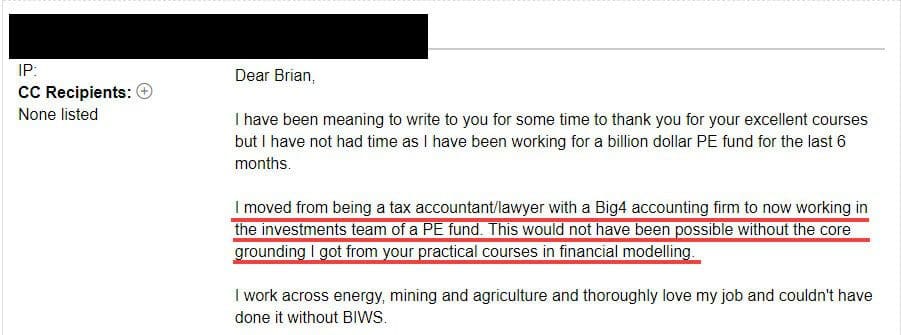
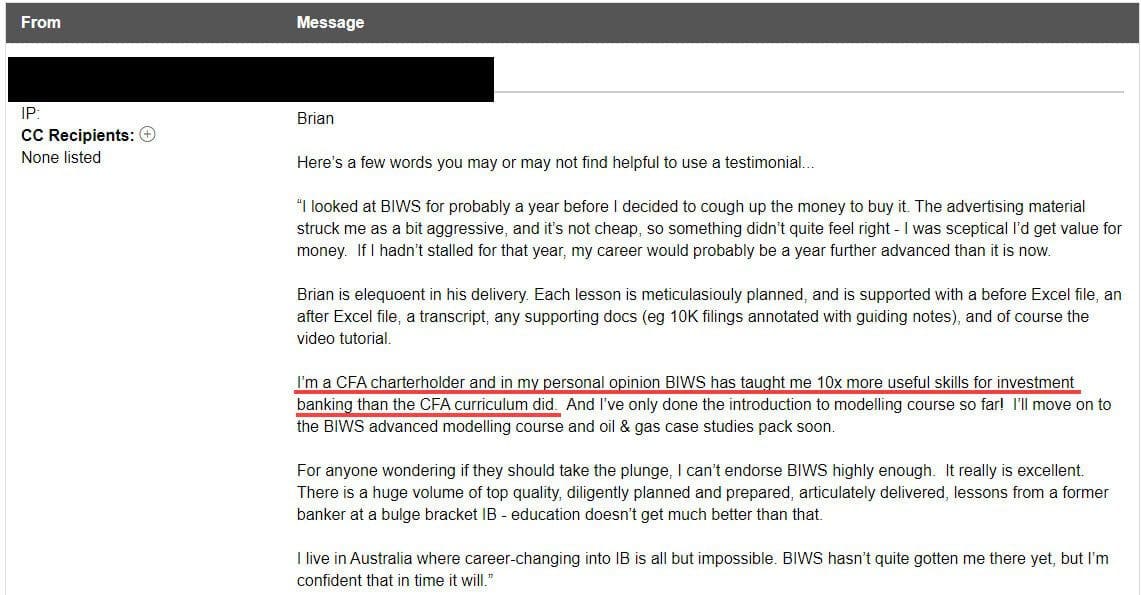
"I can't endorse BIWS highly enough."
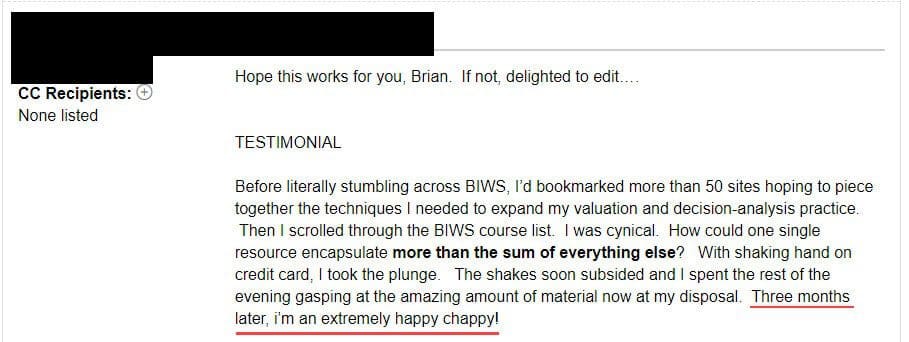
"I'm an extremely happy chappy!"
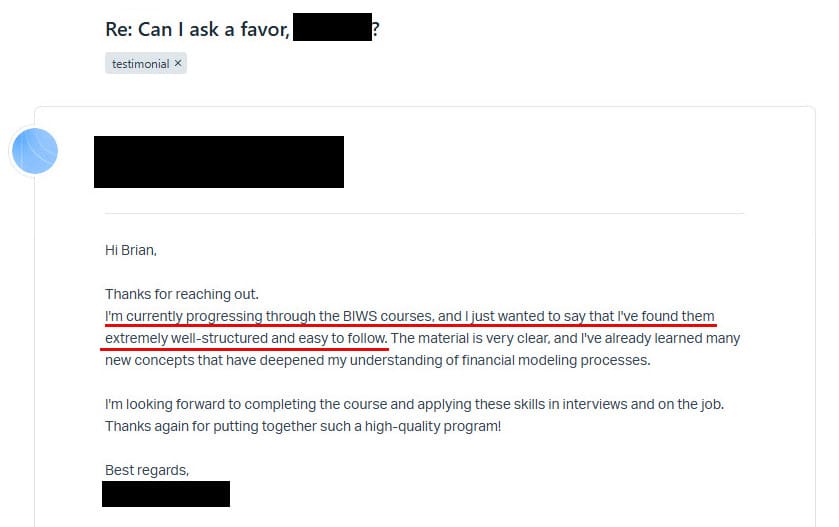
"I've found them extremely well-structured and easy to follow."
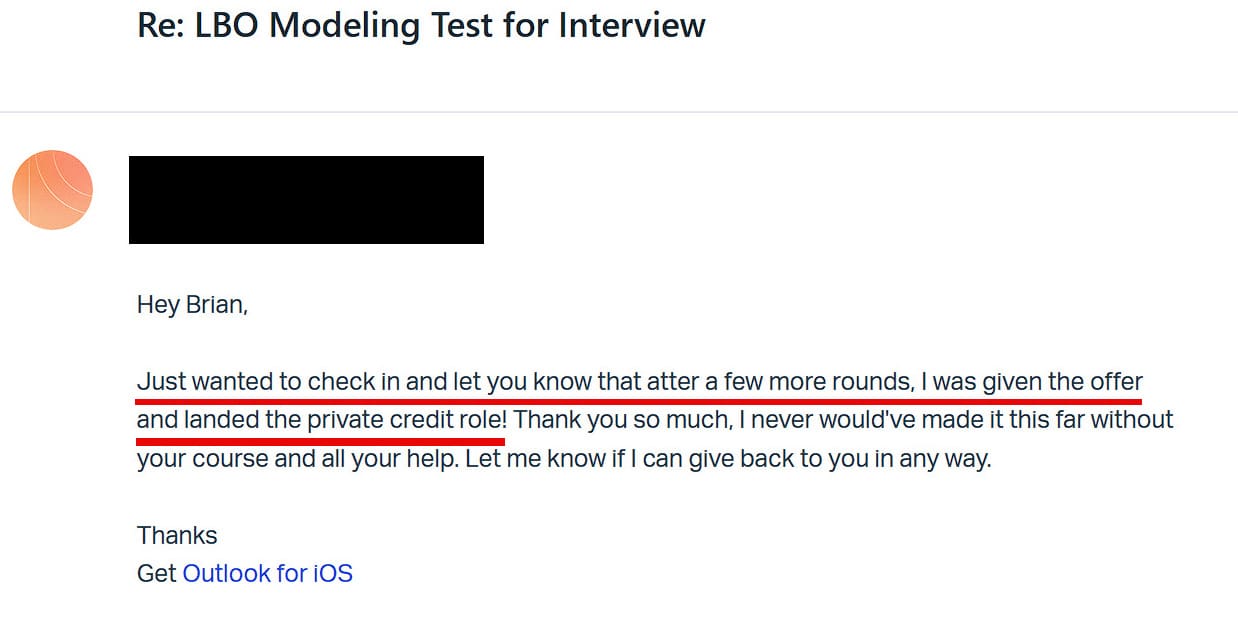
"I was given the offer and landed the private credit role!"
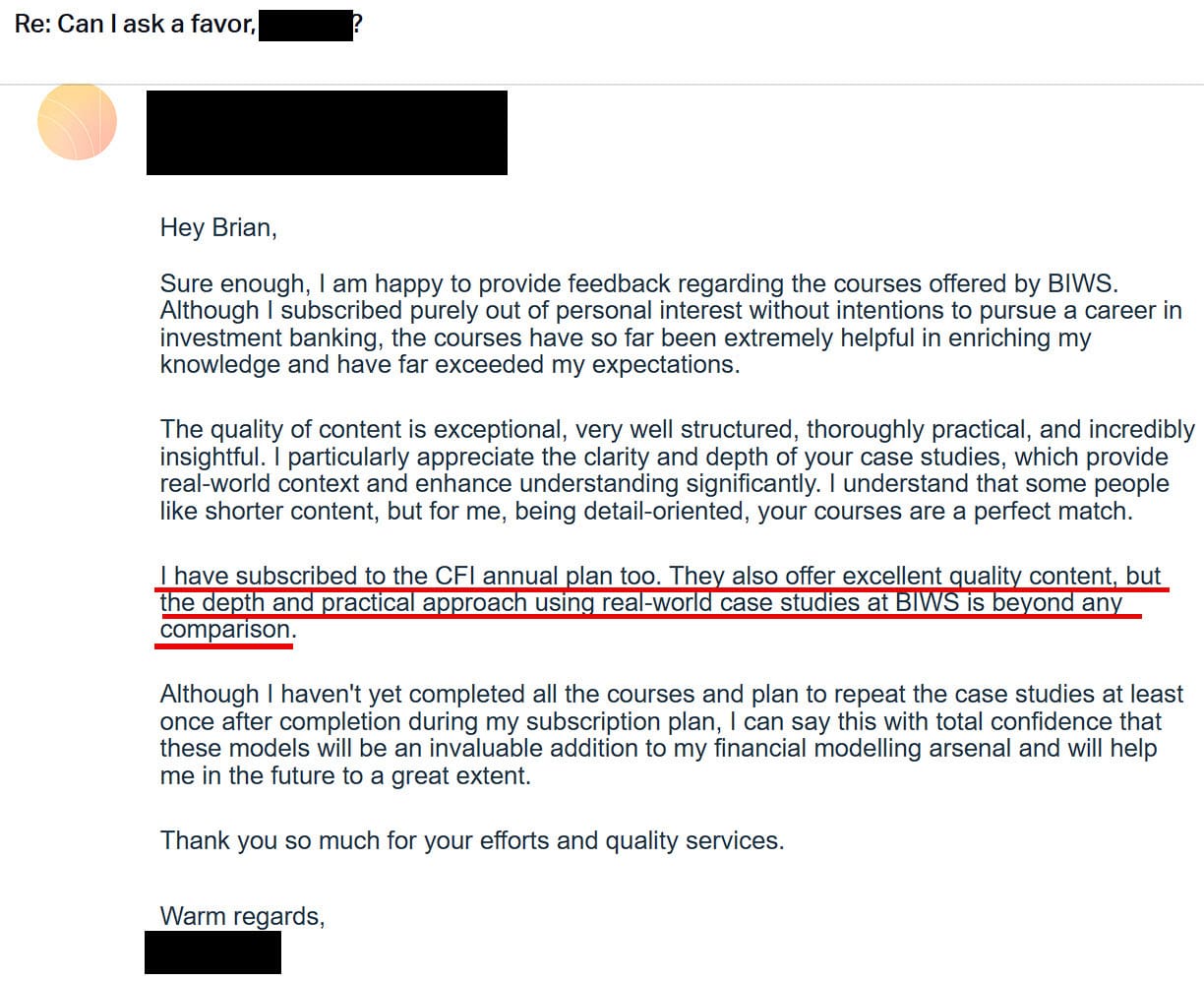
"The depth and practical approach using real-world case studies at BIWS is beyond any comparison."
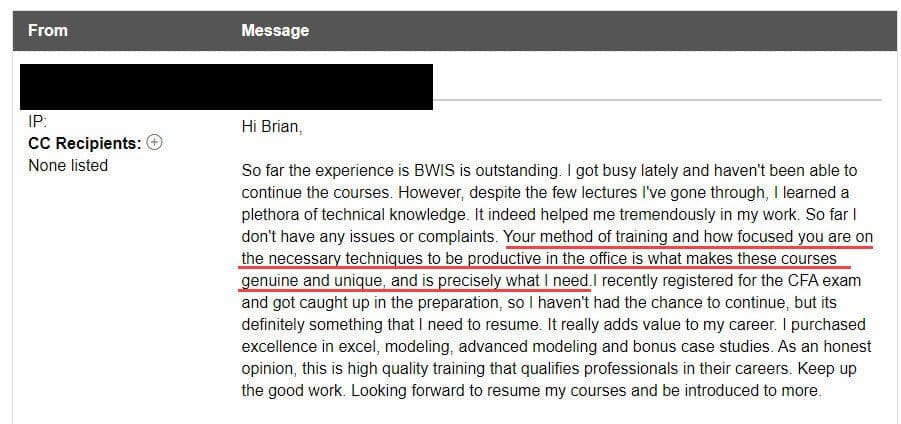
"This is high quality training that qualifies professionals in their careers."
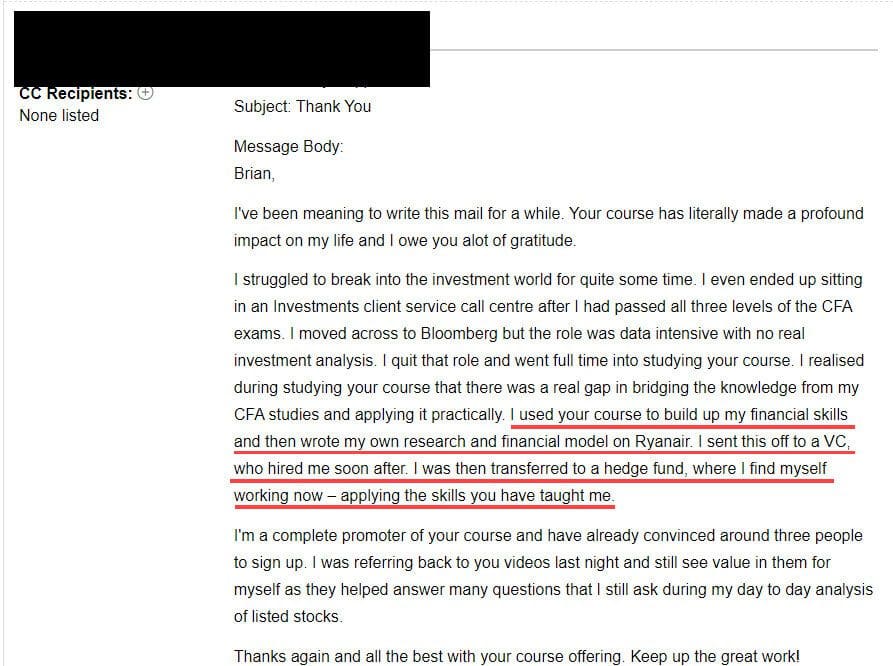
"Your course has literally made a profound impact on my life."
Just 1 Payment of $197
(100% Unconditional Money-Back Guarantee)
Installment Plans Available (Pay in 4 Monthly Installments)
Get Instant Access to the PE Funds of Funds and Secondaries Course
Proceed to checkout
100% Unconditional Money-Back Guarantee