


About Brian DeChesare
Brian DeChesare is the Founder of Mergers & Inquisitions and Breaking Into Wall Street. In his spare time, he enjoys lifting weights, running, traveling, obsessively watching TV shows, and defeating Sauron.
The private equity waterfall determines how the Limited Partners (LPs) in a PE fund earn back the capital they invested and the percentage of the investment profits that goes to the GP in the form of Carried Interest; it factors in the timing of the cash flows, the fees, and the hurdle rate and “catch-up” assumptions to do this.
The private equity waterfall determines how the Limited Partners (LPs) in a PE fund earn back the capital they invested and the percentage of the investment profits that goes to the GP in the form of Carried Interest; it factors in the timing of the cash flows, the fees, and the hurdle rate and “catch-up” assumptions to do this.
Private equity salaries, bonuses, and carried interest are known to be high, but they are also highly variable (you can view our summary table here).
Salaries and bonuses mostly come from the fixed Management Fees that PE funds charge; these are typically 2.0% of the LPs’ Committed Capital, falling to 1.0% or 1.5% of the portfolio’s remaining cost basis after the investment period.
The Carried Interest is normally 20% of the investment profits and goes primarily to the Partners of the PE firm.
It might take nearly a decade to realize, and the fund must achieve a minimum annualized return, called the “Hurdle Rate,” before the Carry can be distributed.
This requirement aligns LP and GP interests and ensures the LPs earn a minimum performance before paying high fees.
The mechanics for a basic private equity waterfall look like this:
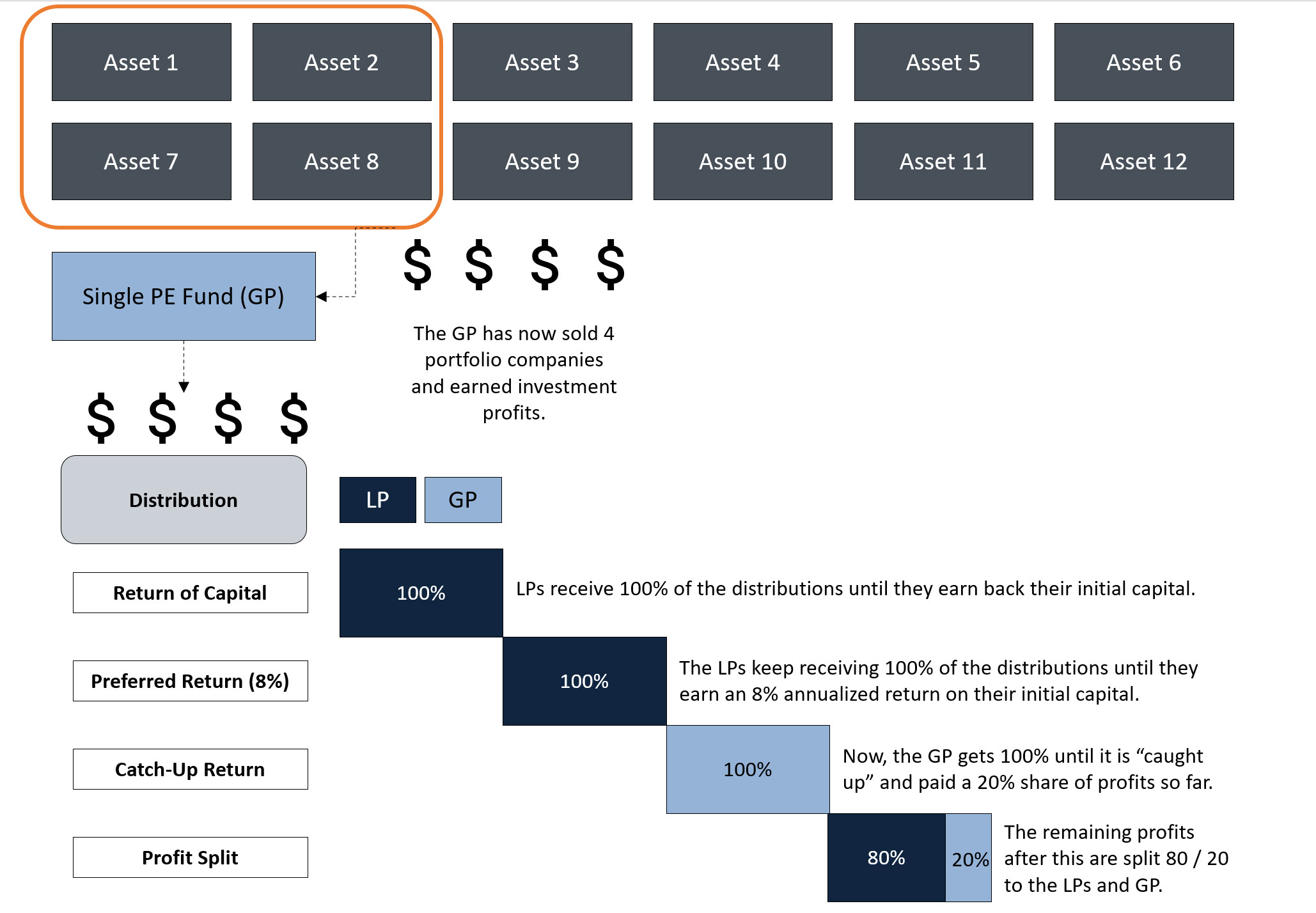
We’ll cover a simple private equity waterfall example to calculate Carried Interest below, but let’s start with two points about PE compensation that people often overlook:
1) Fundraising Size and Frequency Matters A LOT – Since Management Fees decrease over time, you should ideally work at a firm that raises new funds frequently, has multiple active funds, and keeps growing its fund sizes over time.
If not, the active funds will eventually wind down, and your compensation will fall because the Management Fees will decline:

This is why base salaries and bonuses are much more predictable at upper-middle-market firms and PE mega-funds.
2) Carried Interest is Highly Sensitive to Small Changes – For example, consider a fund that earns a 1.7x Gross Multiple of Invested Capital (MOIC) over 10 years vs. one that earns a 1.6x Gross MOIC over 10 years.
This doesn’t seem like a big difference; a slightly worse exit for a single portfolio company could explain it.
But the delayed timing and a slightly lower multiple could make a huge difference on the Carried Interest that goes to each Partner (the example below uses a $1 billion fund):

A European waterfall calculates Carried Interest at the fund level across all investments, while an American waterfall calculates it separately for each portfolio company.
The example in this article uses a European waterfall structure, so the GP receives no Carry until the entire fund has returned all the LPs’ contributions plus their Preferred Return.
This structure is simpler to model because you do not need separate waterfalls for the portfolio companies, and it favors the LPs because it aligns the GP’s incentives with the fund’s overall performance.
The American waterfall structure is much more favorable to the GP because it lets them earn Carry as soon as a single deal exceeds the Hurdle Rate, even if other investments underperform.
However, this can also create negative consequences later because clawback provisions may require the GP to return Excess Carry if the overall fund underperforms.
Before you can forecast the Carry, you need to know how much capital the fund raises, how it invests that capital over time, and the expected realizations from its investments.
The main assumptions here are as follows:
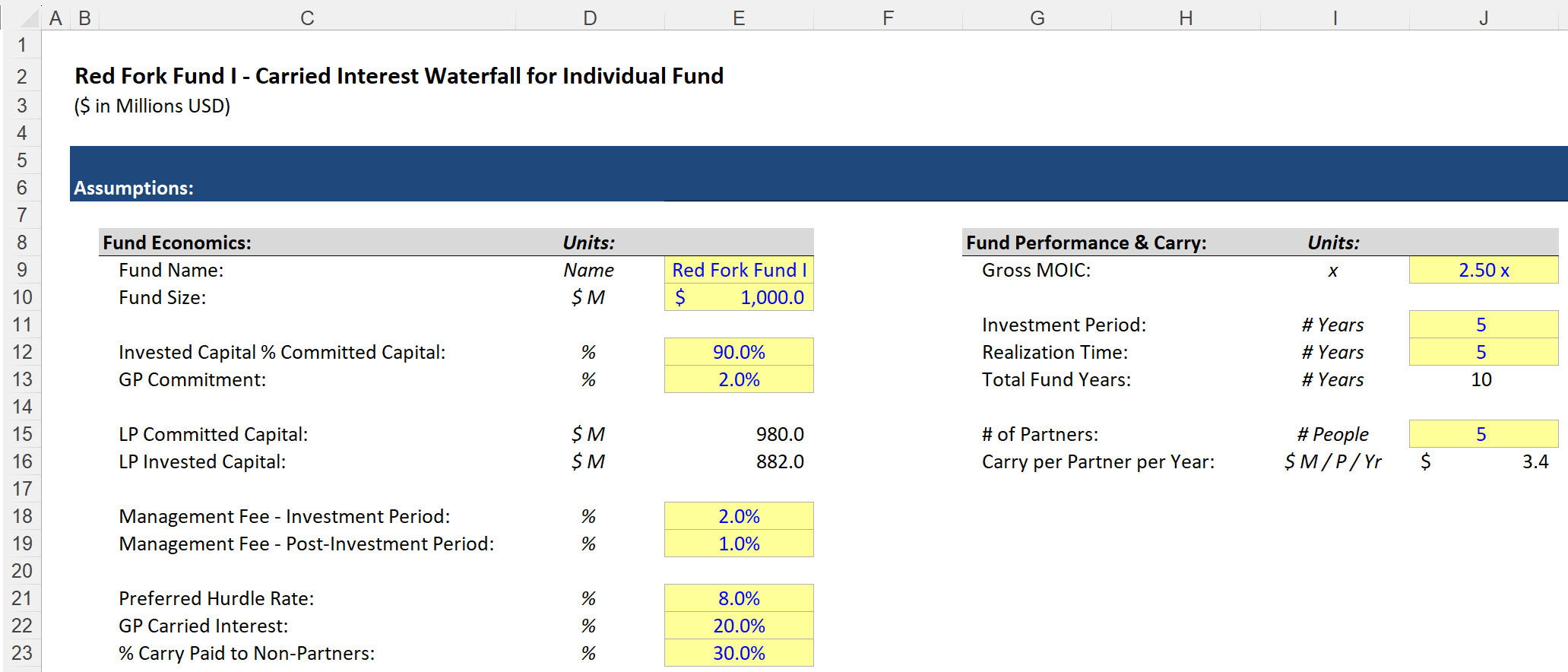
With these assumptions, the fund invests the $882 million evenly over 5 years, earns a Management Fee of 2% * $980 million = $19.6 million per year, and switches to 1.0% * Remaining Cost Basis after the first 5 years.
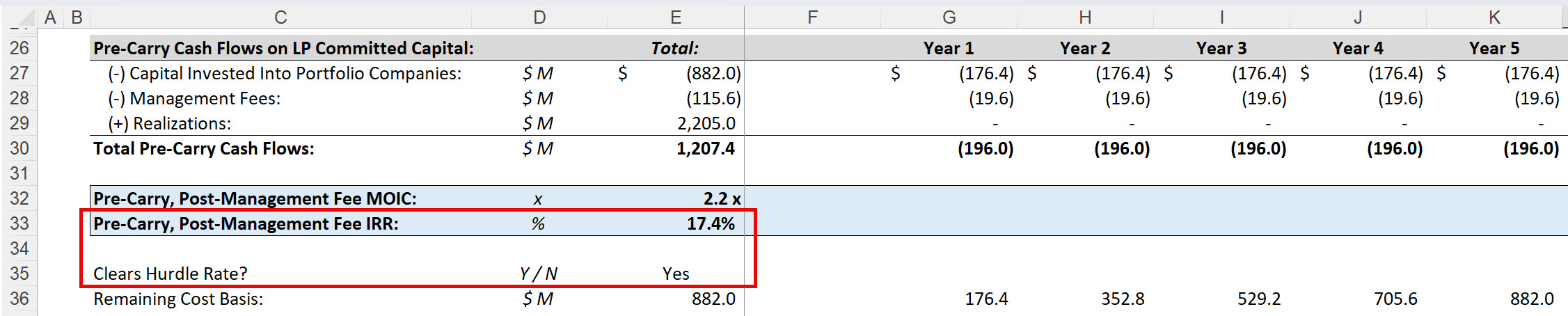
The Realizations start in Year 6, and each one is based on 2.5x * the capital invested into portfolio companies 5 years before:

We can approximate the Remaining Cost Basis by adding the cumulative investments into portfolio companies and subtracting the cumulative Realizations / Gross MOIC.
Based on these simple numbers, we can tell that Carried Interest will be distributed because the IRR is 17%, which is above the 8% Hurdle Rate:
Before anything else can happen, the LPs must earn back their Called Capital, which equals the Investments + Management Fees.
So, in this tier, you add the Called Capital to the running balance each year, and you assume a repayment based on the minimum between the funds available and the running balance.
The “funds available” come from the Realizations, if there are any in this period:
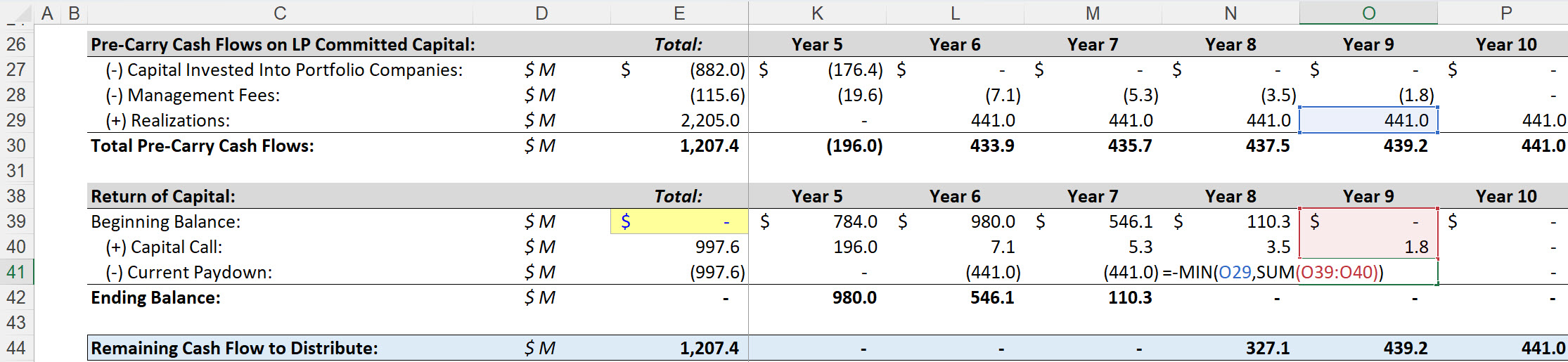
As the final step, you take the Realizations and subtract the Payout in this tier to determine the Remaining Cash Flow to Distribute, which is used in the next tier.
The Preferred Return ensures that the LPs earn a certain minimum annualized return on their capital before the Partners of the PE firm receive anything.
The basic setup is like the Return of Capital tier, but the Accrual is based on (Beginning Preferred Return Balance + Beginning Return of Capital Balance) * 8.0%:
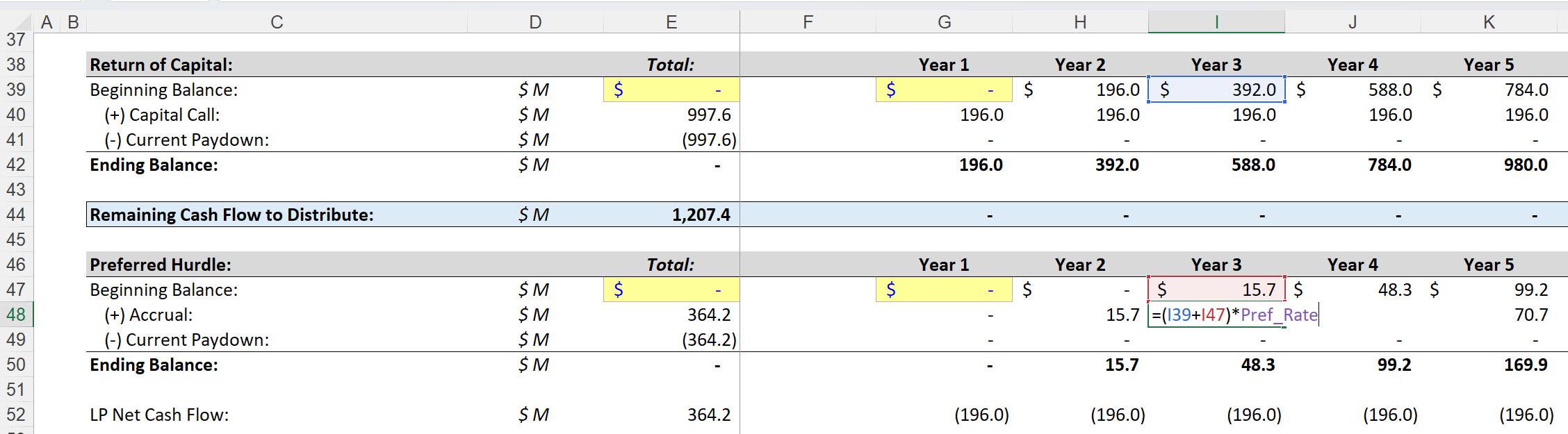
The payout is based on the minimum between the Remaining Cash Flow to Distribute from the previous tier and the owed/running balance in this tier.
We can also make a quick IRR calculation on all the cash flows to the LP to ensure they satisfy the 8.0% Hurdle Rate:

In the next step, the GP is “caught up” based on 20% of the investment profits corresponding to the 8% Hurdle Rate, provided the Limited Partners have received their Preferred Return first.
For example, let’s say that the LPs earn a $100 Preferred Return in one year.
To calculate the GP Catch-Up, we first divide the $100 by 80% to “gross it up” to the total available investment profits:
$100 / 80% = $125
Then, we say that the GP earns 20% of this total:
$125 * 20% = $25
If there’s enough cash flow remaining in this period to pay for this $25, this is the GP Catch-Up.
If the cash flow is insufficient, some or all of this is added to the running balance owed to the GP.
The accrual in this tier is based on the LPs’ Preferred Return / 80%:
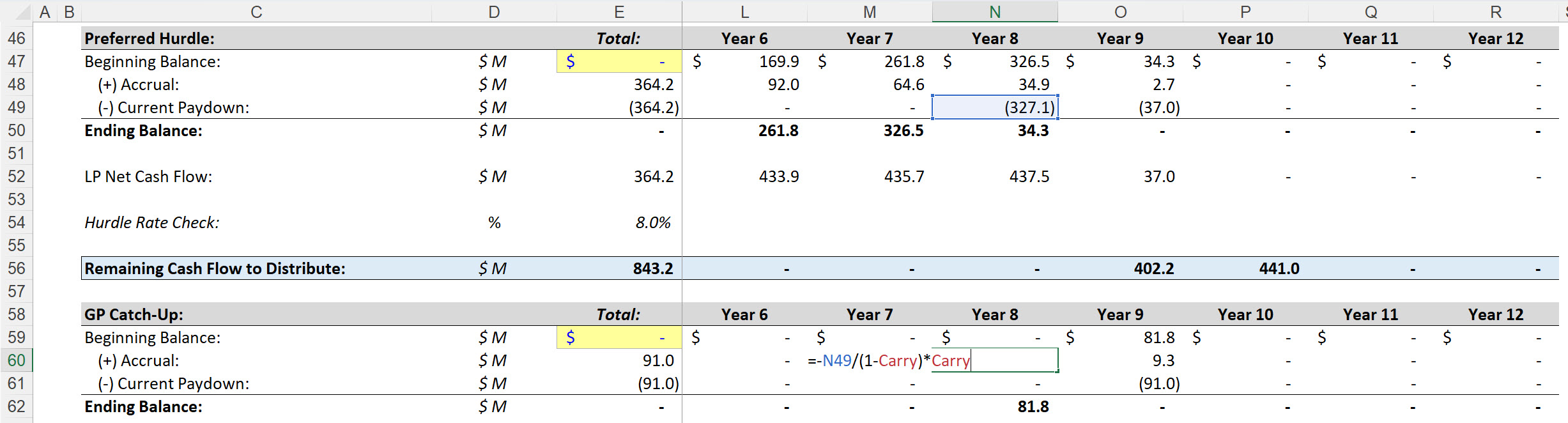
We pay out the GP Catch-Up based on the minimum between the Remaining Cash Flows to Distribute and this running balance.
Once the Preferred Return and GP Catch-Up Return have been paid, we split the remaining cash flows 80% / 20% between the LPs and the GP:
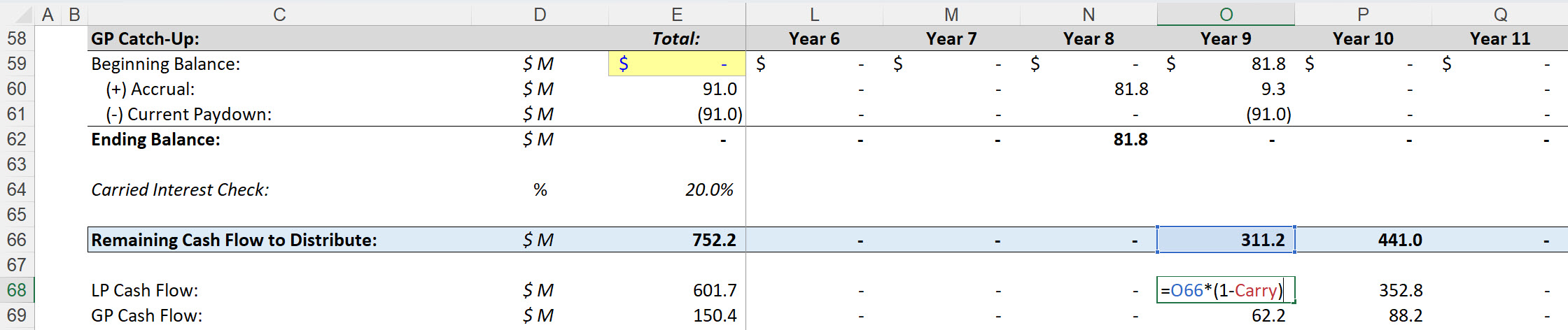
To determine the LP Profit, we add the Preferred Return and the 80% Cash Flow Split, and for the GP Profit, we add the Catch-Up Return and the 20% Cash Flow Split.
In this case, with a 2.5x MOIC for the entire fund, it’s the targeted 80% / 20% split between the LPs and the GPs.
But if this fund produced a “borderline” performance, such as a 1.7x multiple, it would be more like a 90% / 10% split:
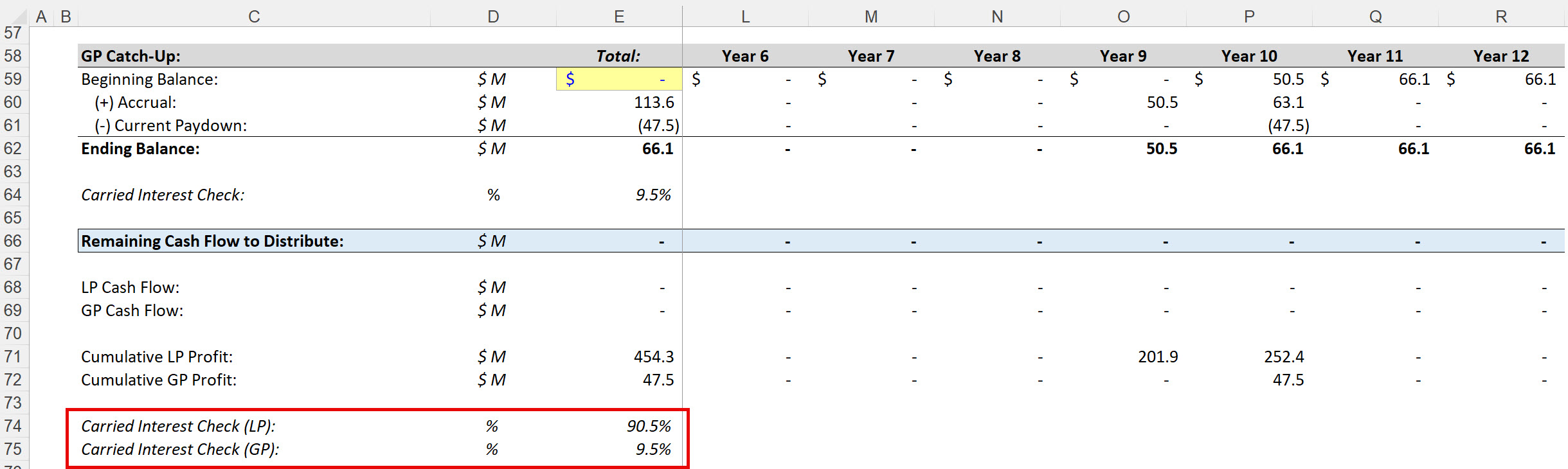
At this 1.7x multiple, the fund clears the Hurdle Rate, but cash flow isn’t enough to fully catch up the GPs.
The private equity waterfall determines the *total* Carried Interest available to everyone, but the per-Partner-per-year numbers depend on the number of Partners, the fund life, and the percentage that goes to non-Partners.
In this example, we assume there are 5 Partners and that 30% is reserved for the non-Partners, such as the Associates, VPs, Principals, other staff in different functions, and future hires.
Here are a few scenarios to illustrate the sensitivity:
This scenario was shown at the top. These results might seem close, but the 1.7x multiple produces $700K per Partner per year in Carry, while the 1.6x multiple produces nothing!
These outcomes might not seem too different; a single delayed portfolio company exit or market downturn might explain them.
But with a 2.0x multiple over 8 years, it’s $2.8 million per Partner per year in Carry, while the 1.8x multiple over 10 years reduces this to $1.7 million, a drop of nearly 40%:

You might assume that the shorter, 8-year period “offsets” the lower multiple, but that’s not true.
A fund that produces a 2.2x multiple over 10 years delivers higher Carried Interest, at $2.6 million per Partner per year vs. $2.1 million for the 1.8x multiple:

In real life, despite what many PE firms claim in their marketing materials, fund performance varies widely but generally falls as fund sizes grow.
You can see how variable real-life PE fund performance is by reviewing the public disclosures from firms like TPG and Hamilton Lane.
You must also understand these dynamics when you complete funds of funds and secondaries case studies, as you’ll be expected to understand performance differences over time.

Brian DeChesare is the Founder of Mergers & Inquisitions and Breaking Into Wall Street. In his spare time, he enjoys lifting weights, running, traveling, obsessively watching TV shows, and defeating Sauron.

