


How to Calculate Enterprise Value: The Enterprise Value Bridge (11:26)
To calculate Enterprise Value, start with a company’s Equity Value (Share Price * Diluted Share Count) and add Debt, Preferred Stock, Noncontrolling Interests, and other Non-Operating Liabilities, and subtract Cash and other Non-Operating Assets.
Enterprise Value Bridge
How to Calculate Enterprise Value
To calculate Enterprise Value, start with a company’s Equity Value (Share Price * Diluted Share Count) and add Debt, Preferred Stock, Noncontrolling Interests, and other Non-Operating Liabilities, and subtract Cash and other Non-Operating Assets:
This free tutorial from our Core Financial Modeling course will walk you through the process and a simple exercise for Goodyear, the U.S.-based tire manufacturer.
You can read the steps below or watch the video above if you learn better by watching.
Video Table of Contents:
- 1:16: Part 1: Enterprise Value Bridge Logic
- 4:19: Part 2: Exercise: Goodyear’s TEV Bridge
- 9:15: Part 3: What Makes This More Complicated?
- 10:18: Recap and Summary
Files & Resources:
- How to Calculate Enterprise Value – “Before” File (XL) | “After” File (XL)
- How to Calculate Enterprise Value – Presentation Slides (PDF)
- How to Calculate Enterprise Value – Video Transcript (PDF)
- Goodyear – Highlighted 10-K (PDF) | 10-K Key Excerpts (PDF) | 10-Q (PDF)
What is Enterprise Value?
Enterprise Value is the value of the company’s core business operations (i.e., Net Operating Assets), but to ALL INVESTORS (Equity, Debt, Preferred, and possibly others) in the company.
Equity Value is the value of EVERYTHING a company has (Net Assets, or Total Assets – Total Liabilities), but only to EQUITY INVESTORS (common shareholders). This is also known as “Market Capitalization” or “Market Cap,” and Bloomberg and CNBC hosts like to ramble on about it.
To move from Equity Value to Enterprise Value, you subtract Non-Operating Assets (Cash, Investments, etc.), and you add Liability & Equity line items that represent other investor groups beyond the common shareholders (Debt, Preferred Stock, etc.).
You need both Equity Value and Enterprise Value because when you analyze companies, you often need to move between them.
For example, one analysis might produce a company’s Implied Enterprise Value as output (“implied” means “your estimate”), but another analysis might require its Equity Value as input.
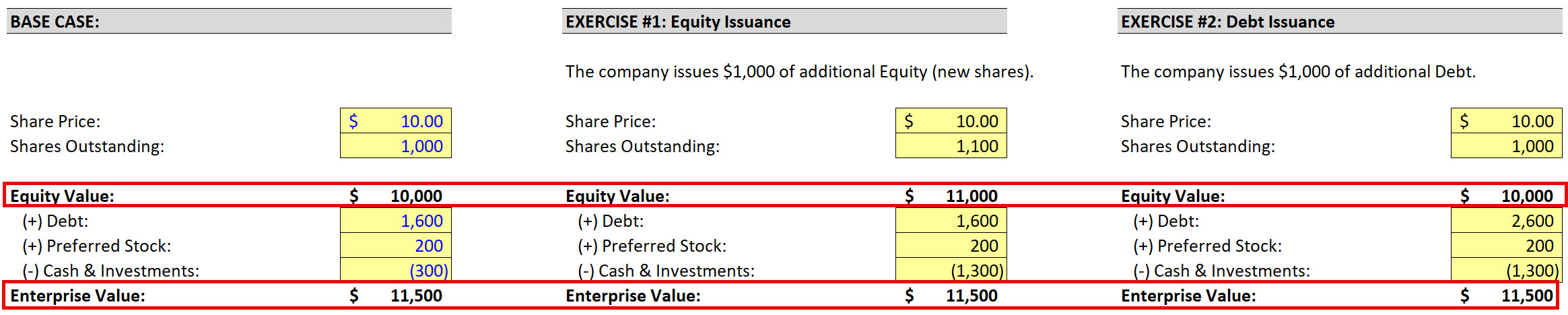
But the bigger issue is that if a company’s capital structure (the percentages of Equity and Debt it uses) changes, Equity Value could also change!
By contrast, Enterprise Value will not change – or at least, not by nearly as much – even if the company’s capital structure changes.
Therefore, Enterprise Value lets you analyze a company without worrying about its capital structure; you can focus on its core business of selling and delivering products to customers.
Here’s a simple example illustrating that Enterprise Value stays the same even when a company issues Debt or Equity:
How to Calculate Enterprise Value: The Basic Bridge
To start the process, you need the company’s Equity Value first.
You can find the company’s current share price on any finance site (Google/Yahoo Finance, FinViz, etc.).
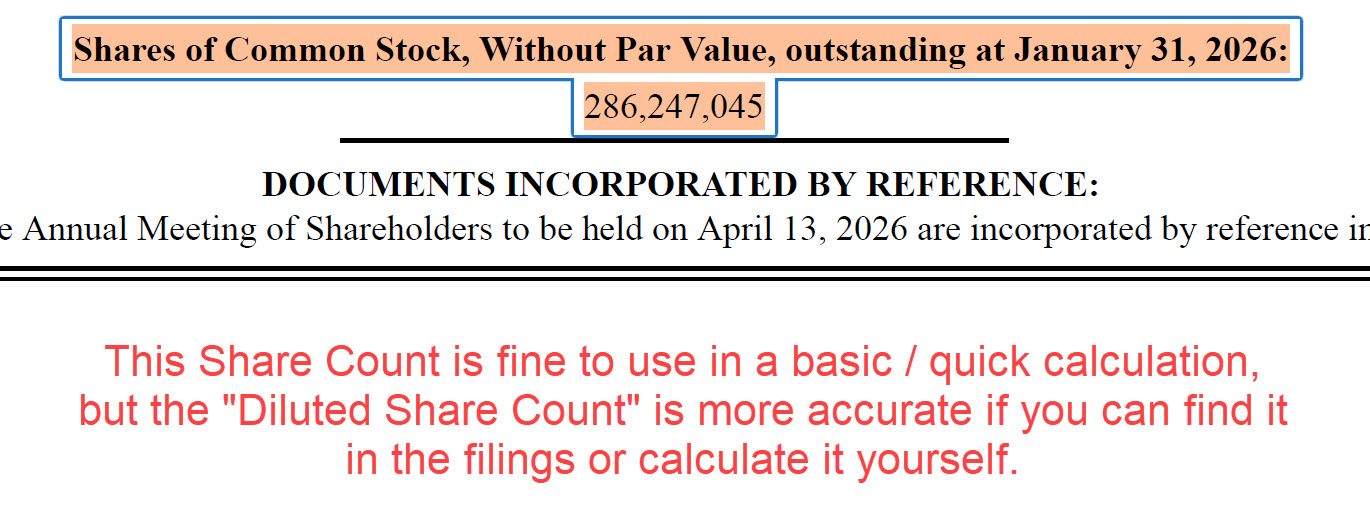
Then, you can find its share count on the cover of its most recent annual or quarterly report.
In this example for Goodyear, we looked up its share price on the valuation date (2026-03-20) and found its share count in its 10-K annual report, though we modified it a bit by factoring in “dilutive securities,” such as stock options:
After you get the company’s Equity Value, you can go to its most recent Balance Sheet as of the valuation date to subtract the Cash and Investments and add the Debt, Preferred Stock, and Noncontrolling Interests:
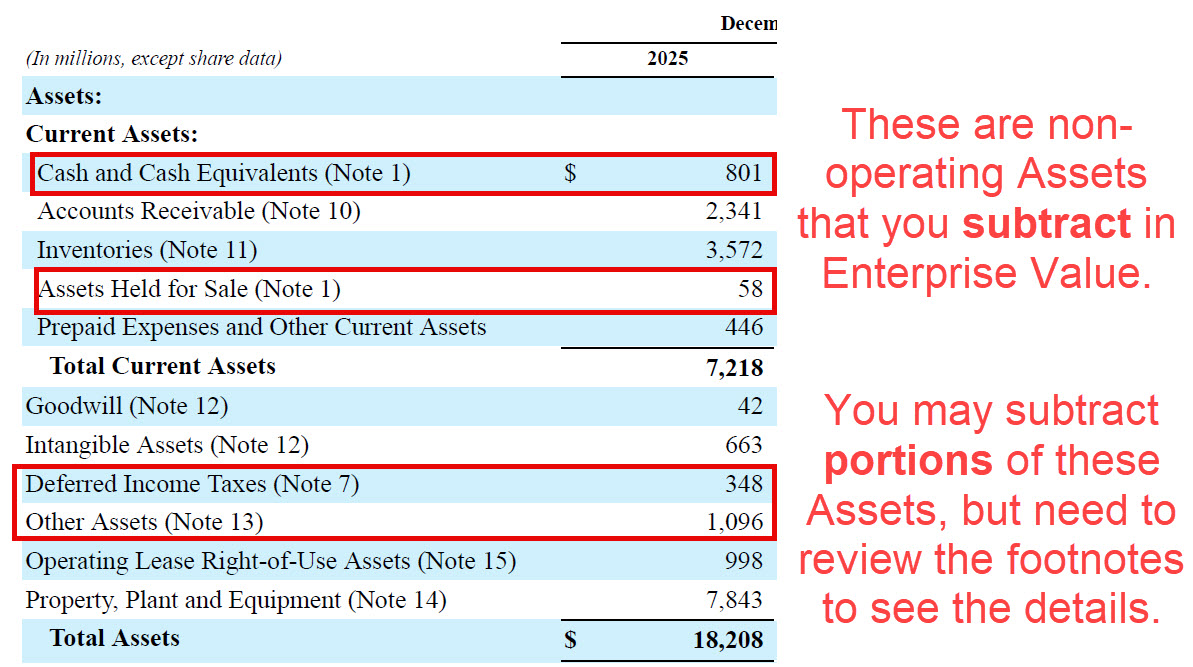
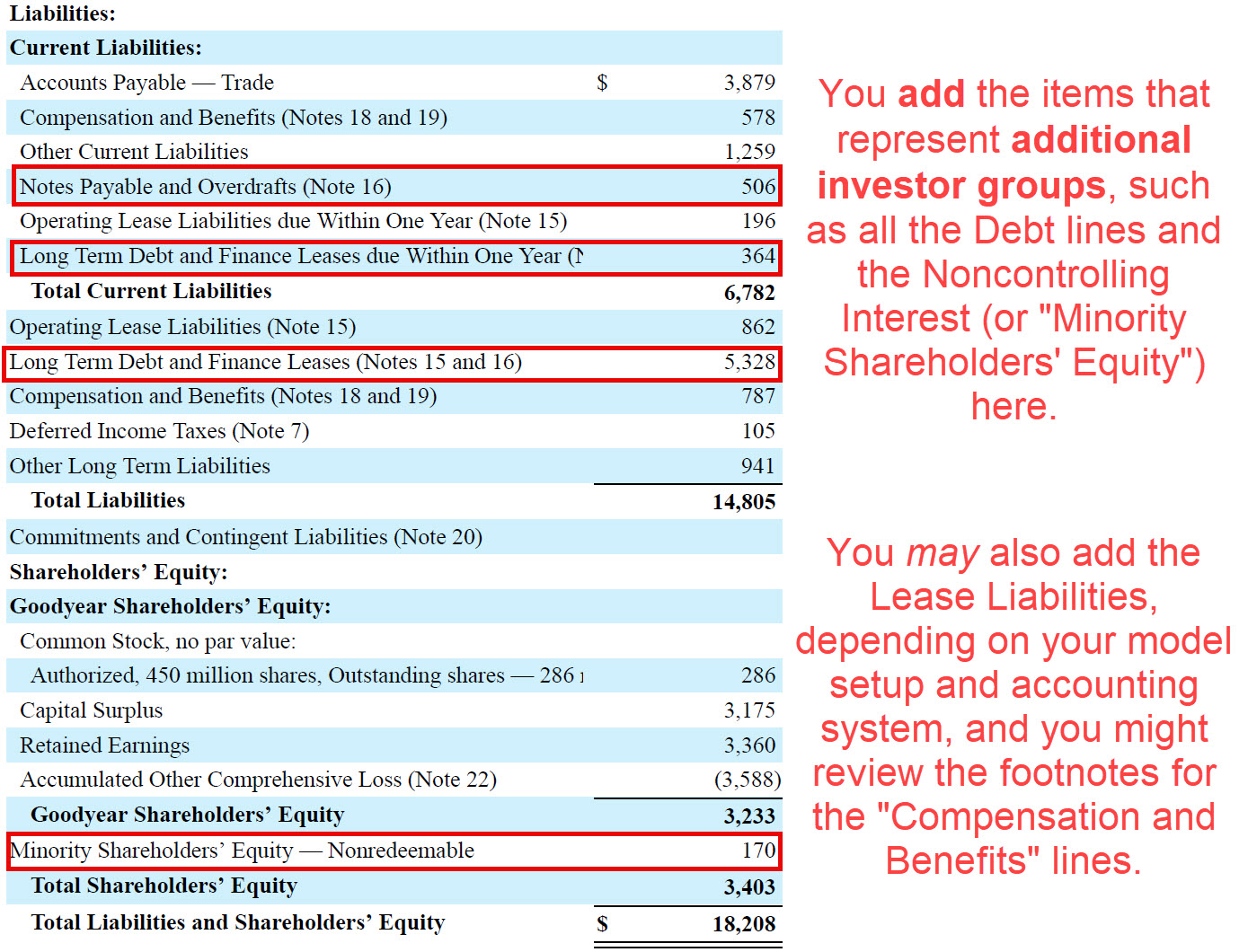
It would be better to count Debt and Finance Leases separately, but the company has grouped them on its Balance Sheet, and we haven’t yet reviewed the footnotes for the full details.
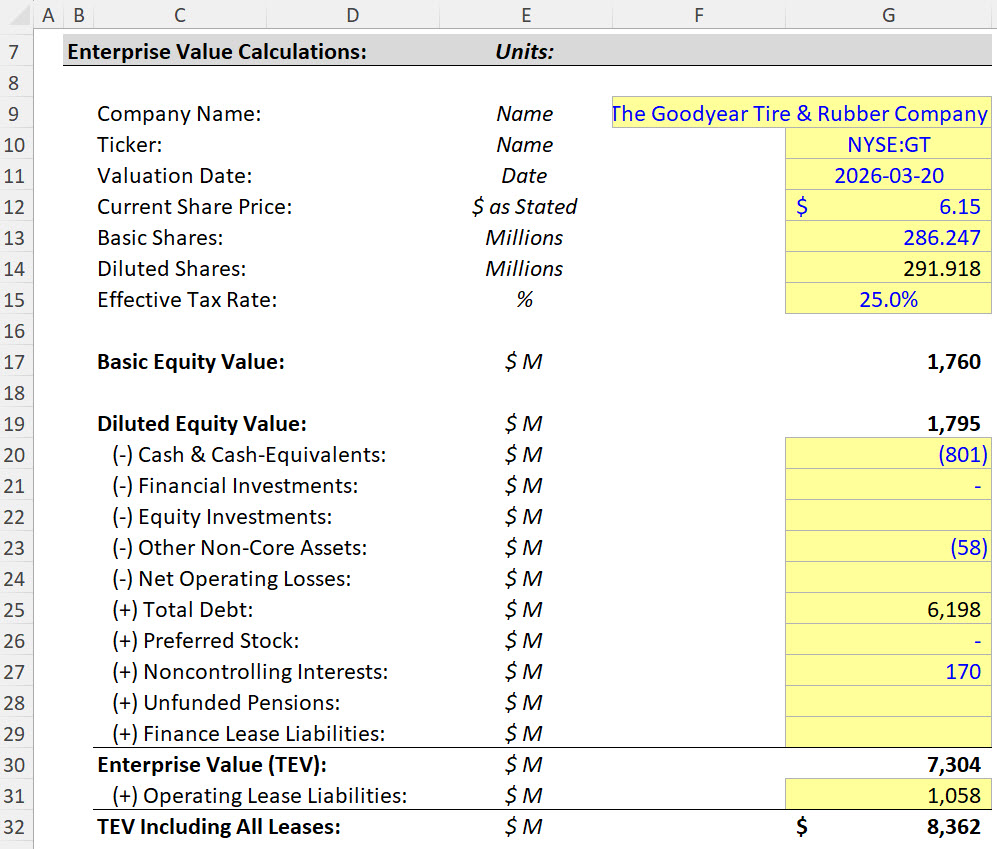
A “first pass” of the Enterprise Value calculation matches the image at the top of this article:

-
Become a financial modeling pro
158 videos, detailed written guides, Excel files, quizzes, and more
-
Complete 10+ detailed global case studies
These include both the theory and the practical applications
-
Prepare for your internship or full-time job
Gain the skills you need to “hit the ground running” on Day 1
How to Calculate Enterprise Value: What Makes It More Complicated
Based on this quick tutorial, you might think it’s “easy” to calculate Enterprise Value.
And it is… if you just want a simple calculation that does not dig into the numbers.
This is why tools and services like Capital IQ have been able to calculate Enterprise Value automatically for any public company for decades: They retrieve the key numbers from the financial statements based on simple keyword matching.
But several issues can make it more complicated.
First, there may be timing differences that you have to factor in.
Normally, you always want to use the most recent financial report available as of the valuation date, such as the quarterly report if Q2 of the company’s fiscal year has just ended.
This quarterly report always has a Balance Sheet, so items like Cash and Debt are no problem, but you may not be able to find everything in the quarterly version.
For example, if you adjust any of the items to their market values, or you include more advanced items, such as pensions, you might have to go back to the annual version of the reports and “mix and match” the numbers from different periods.
Another issue is that some companies’ Balance Sheets have more advanced line items that require nuance.
A few examples include:
- Leases – The treatment of Lease Liabilities depends on the metrics you are using with Enterprise Value and the accounting system (S. GAAP vs. IFRS). You normally want to add all Lease Liabilities under IFRS but add only Finance Lease Liabilities under U.S. GAAP. It gets complicated, so please see our lease accounting tutorial.
- Market Values – Whenever possible, you should try to find the market values or fair values of items like Debt and use them in the bridge, rather than the “book values” shown on the Balance Sheet.
- Equity Investments – These represent the parent company’s minority stakes (< 50% ownership) in other companies. They are not directly disclosed on the Balance Sheet here, so you need to hunt for them. See our tutorial on the equity method of accounting.
- Pensions – If a defined-benefit pension plan is unfunded or underfunded, it counts as a Debt-like Liability in the TEV bridge. But the specifics are a bit tricky, as you may need to adjust financial metrics when adding this line item and multiply by (1 – Tax Rate) if contributions into the pension plan are tax-deductible.
- Net Operating Losses (NOLs) – If a company has lost money in the past (negative Pre-Tax Income), it may be able to use these accumulated losses to reduce its Taxable Income in the future. But factoring this into the TEV bridge is tricky because you may need to adjust the numbers due to NOL expirations and other limitations. For more, see our NOL tutorial.
How to Calculate Enterprise Value: The More Advanced Version
Putting together everything above, here’s an example of a more advanced Enterprise Value bridge for Goodyear.
Since it’s based on a valuation date in June, it uses the company’s Balance Sheet from its Q1 quarterly report (ending March 31). It also factors in the more advanced items noted above.
In most cases, we had to search the annual and quarterly reports and read through the footnotes to find the disclosures for these items, but various AI/automation tools can do this as well (you need to check and verify all the numbers because these tools are often wrong):
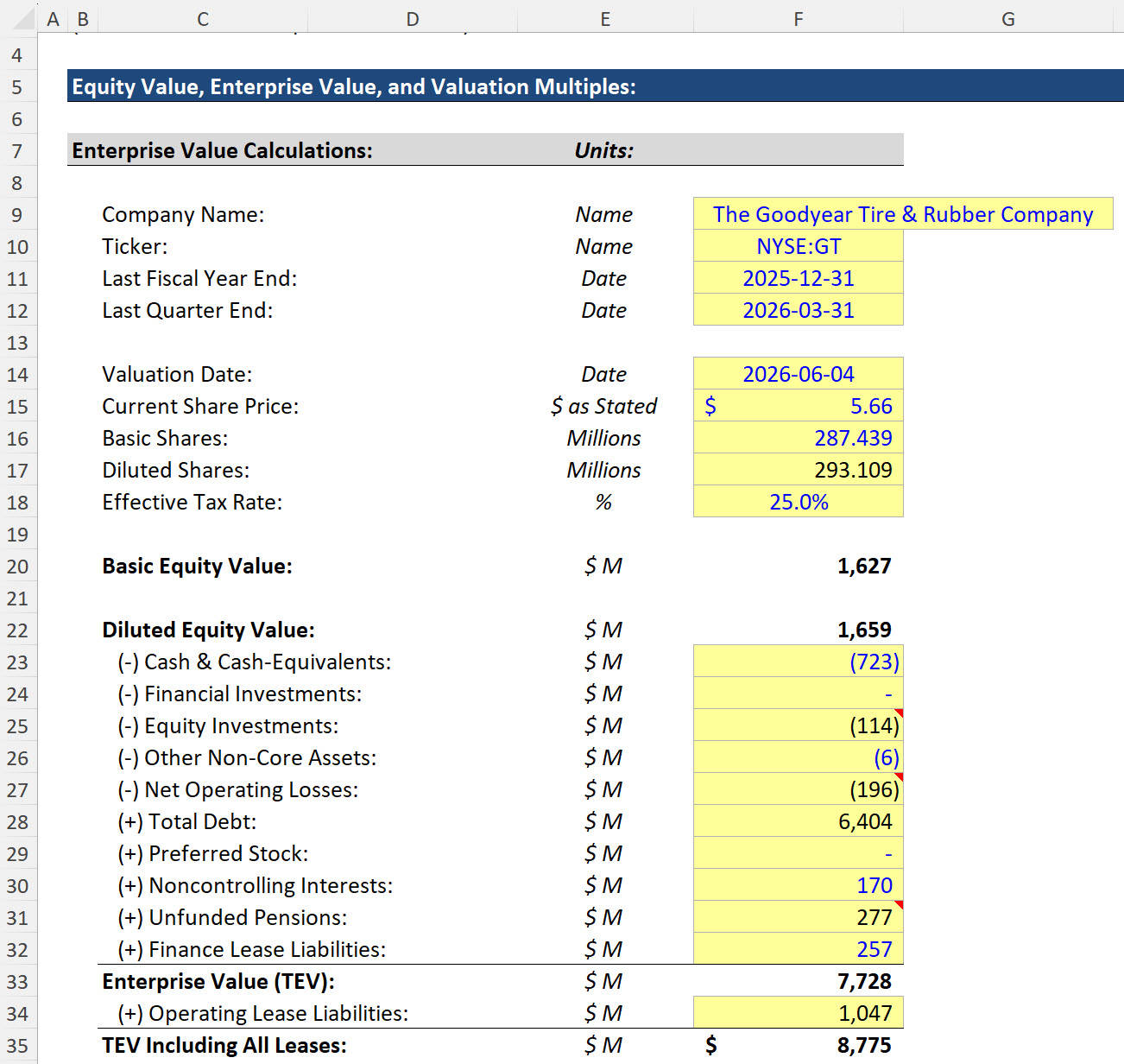
The “TEV Including All Leases” metric at the bottom is a variation of Enterprise Value intended to be used with the EBITDAR (Earnings Before Interest, Taxes, Depreciation, Amortization, and Rent) metric.
This metric is useful when you compare companies that use different accounting systems or that have different leasing vs. ownership policies, as it normalizes all these differences:
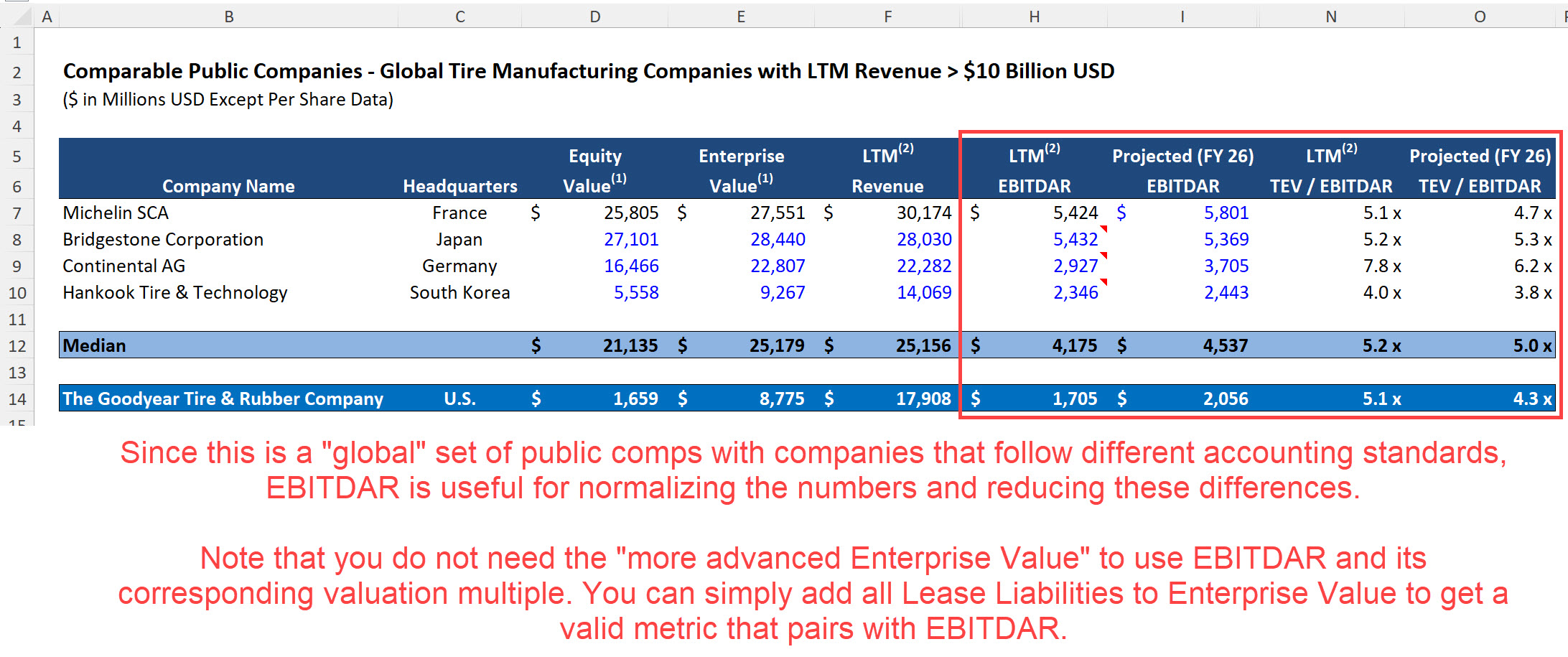
But, as noted above, you do not at all need the “more advanced” version of Enterprise Value to use EBITDAR, and the metric is unrelated to factoring in the timing differences and more complex line items.

About Brian DeChesare
Brian DeChesare is the Founder of Mergers & Inquisitions and Breaking Into Wall Street. In his spare time, he enjoys lifting weights, running, traveling, obsessively watching TV shows, and defeating Sauron.

